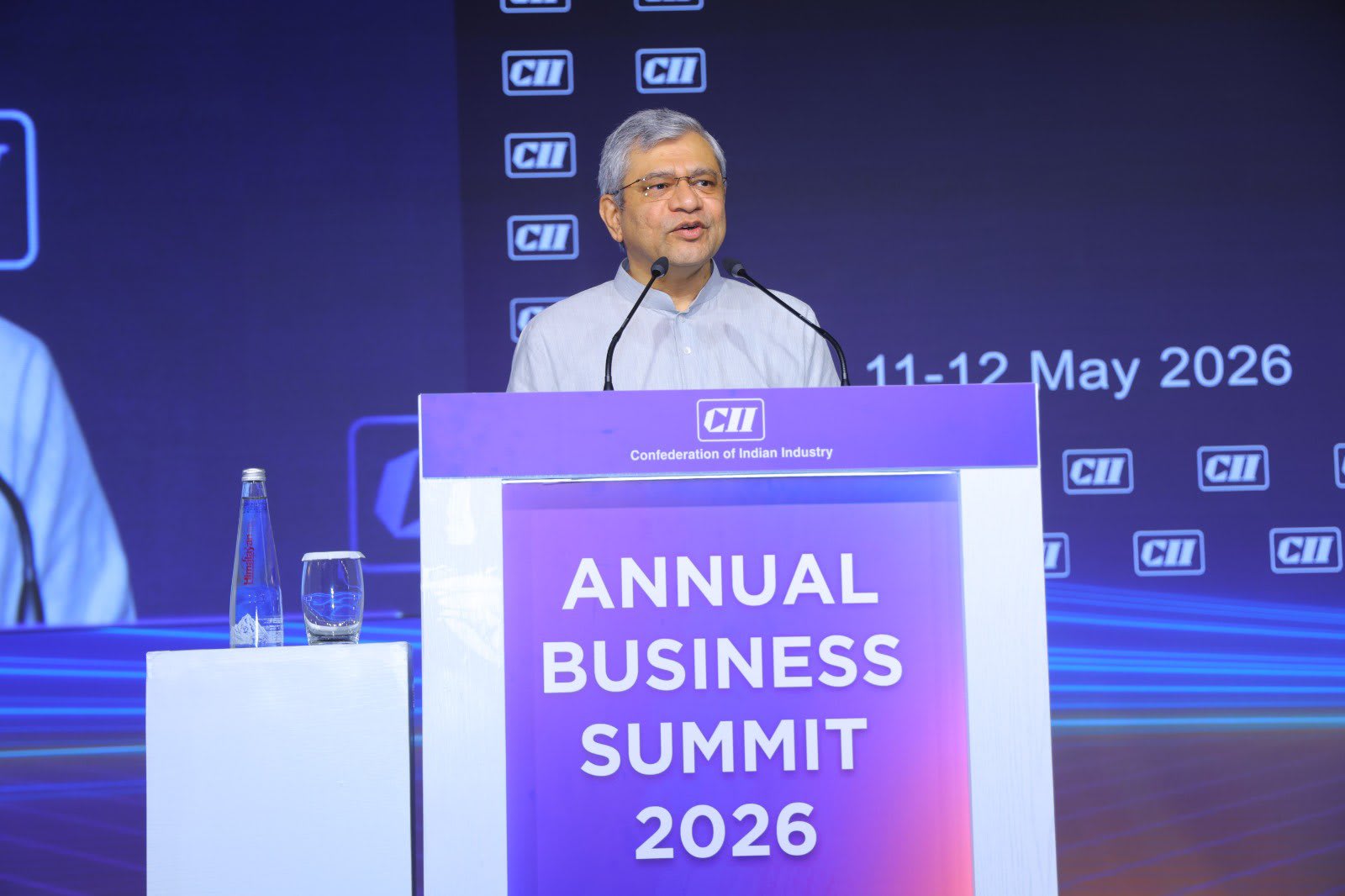
New Delhi: Ashwini Vaishnaw, Minister for Railways, Information & Broadcasting, and Electronics & Information Technology on Monday said that Artificial Intelligence, electronics, semiconductors, and railways will power next phase of transformation in India.
Speaking at the Inaugural Session of the CII Annual Business Summit 2026 in national capital, the Minister highlighting the unprecedented scale of transformation in the Railways sector.
Vaishnaw said railway capital expenditure has increased from approximately Rs 66,000 crore a few years ago to nearly Rs 2,72,000 crore in the last financial year. He noted that the execution capability of the entire railway ecosystem has expanded simultaneously, reflecting a major cultural transformation in project implementation and delivery.
He further stated that nearly 49,000 kilometres of railway tracks have been electrified, equivalent to the entire railway network of Germany. Production of wagons and locomotives has also increased significantly.
The Minister also announced the completion of the Dedicated Freight Corridor project on 5 April, despite multiple implementation challenges.
The Dedicated Freight Corridor is currently enabling the movement of nearly 480 trains per day, while reducing transit time between the hinterland and ports from 48 hours to nearly 12–16 hours.
He also elaborated on the transformative impact of upcoming high-speed rail corridors, explaining how cities connected through these corridors would increasingly function as integrated economic zones.
Vaishnaw emphasised that India’s focus remains firmly on quality, cost competitiveness, and process efficiency — all critical pillars in the journey towards a Viksit Bharat.
On India’s electronics and semiconductor journey, Vaishnaw highlighted a major structural shift in the country’s export profile.
He noted that smartphones emerged as India’s largest exported commodity last year, overtaking traditional export leaders such as diesel, gems and jewellery, textiles, and engineered goods.
As part of the progress under the Make in India mission, India also exported electronic components worth nearly Rs 30,000 crore to neighbouring countries.
The Minister said a new wave of electronics manufacturing facilities across the country is fostering quality-focused and lean manufacturing practices, laying the foundation for a technologically advanced and self-reliant India.
Calling Artificial Intelligence one of the most transformative technological revolutions in history, Vaishnaw said AI is reshaping the world at an unprecedented pace.
He stressed that India must adopt a clear and strategic approach towards AI, ensuring that the country becomes a beneficiary of the technology by leveraging it to improve productivity, quality, and production efficiency across sectors.
Vaishnaw highlighted the government’s focus on strengthening data centre infrastructure, stating that India possesses the capacity, capability, and institutional strength required to harness AI for national growth.
He added that the tax exemptions announced in the Union Budget would further accelerate investments and adoption in this sector.
The Minister also underlined the urgent need for large-scale skilling and talent development to fully capture the AI opportunity. He urged industry bodies such as the Confederation of Indian Industry to take a leadership role in preparing the workforce with the right capabilities and future-ready skills.
Comments (0)
Be the first to comment!