
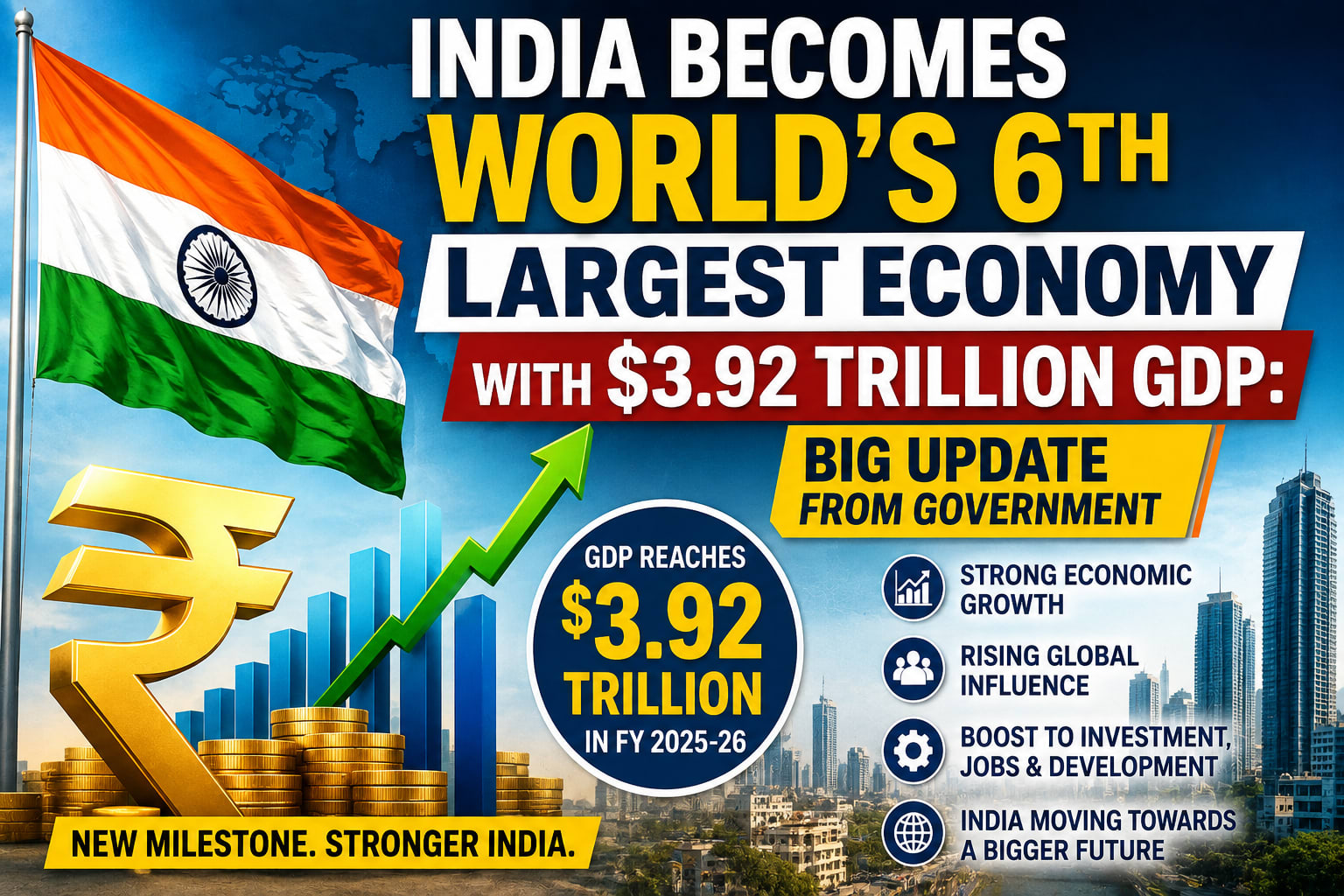
India has emerged as the world’s sixth-largest economy, with its nominal Gross Domestic Product (GDP) reaching approximately $3.92 trillion in fiscal year 2025-26, according to the latest data from the International Monetary Fund (IMF) cited by the Government of India in Parliament.
The latest development puts India among the world's biggest economies despite changes in global currency valuations and economic rankings. The government informed Parliament on Tuesday that India’s nominal GDP stood at $3.92 trillion in FY2025-26, based on the IMF’s April 2026 World Economic Outlook.
The development comes at a time when India continues to record strong domestic economic growth. Official Indian estimates show that real GDP grew by 7.7% in FY2025-26, while nominal GDP at current prices was estimated at ₹346.36 lakh crore.
But what does India's sixth-largest economy status actually mean? Why did India's global ranking change, and what are the major factors driving the country's economic expansion?
India’s GDP Reaches $3.92 Trillion
GDP is one of the most widely used indicators for measuring the size of an economy. It represents the value of goods and services produced within a country during a specific period.
According to the latest IMF-based figure cited by the government, India's nominal GDP reached around $3.92 trillion in FY2025-26.
This is a significant milestone for an economy that has expanded rapidly over the past decade.
However, it is important to understand that a country's ranking in nominal GDP measured in US dollars can change because of exchange-rate movements as well as changes in domestic economic output.
India's economy can continue to grow in rupee terms while its dollar-denominated ranking changes because the rupee-dollar exchange rate affects the conversion.
This distinction is particularly important when interpreting India's latest sixth-place ranking.
Why Is India Ranked Sixth?
India's position in global GDP rankings is determined by comparing the size of its economy with those of other major countries, usually using nominal GDP converted into US dollars.
The latest IMF estimates put India at approximately $3.92 trillion for FY2025-26.
The change in India's position has been linked partly to revisions in estimates and currency movements. Earlier expectations had placed India higher in global rankings, but updated IMF calculations showed the United Kingdom and Japan ahead of India in nominal dollar terms.
This does not mean that India's domestic economy suddenly became smaller.
Instead, global rankings can move because several variables change simultaneously, including:
Exchange rates
Inflation
GDP revisions
Economic growth in other countries
Changes in national accounting methodologies
Relative movements in nominal GDP
Therefore, India's sixth-place position should be viewed in the broader context of its economic performance.
India Continues to Record Strong Real GDP Growth
One of the most important aspects of the latest development is that India's sixth-place ranking comes alongside strong domestic growth.
According to the Ministry of Statistics and Programme Implementation (MoSPI), India's real GDP growth for FY2025-26 was estimated at 7.7%, compared with 7.1% in FY2024-25.
The fourth quarter of FY2025-26 also recorded estimated real GDP growth of 7.8%.
Nominal GDP at current prices was estimated at ₹346.36 lakh crore in FY2025-26, compared with ₹318.07 lakh crore in the previous financial year.
That represents nominal GDP growth of 8.9%.
These numbers underline an important point: India remains one of the world's major high-growth large economies even though its nominal dollar ranking has changed.
What Is Driving India’s Economic Growth?
Several sectors are contributing to India's economic expansion.
1. Strong Domestic Consumption
India has a massive domestic consumer market. Household spending on food, housing, transport, electronics, financial services, travel and other goods and services continues to support economic activity.
A large population combined with rising incomes creates significant long-term demand potential.
2. Infrastructure Investment
Infrastructure has become another important pillar of India's growth story.
Government spending on roads, railways, airports, ports, logistics networks and urban infrastructure has supported construction activity and created demand across several industries.
Infrastructure development can also improve productivity by reducing transportation costs and connecting businesses with markets more efficiently.
3. Manufacturing Expansion
India is also attempting to strengthen its manufacturing base.
Government initiatives aimed at increasing domestic production, attracting investment and expanding electronics and other industrial sectors have contributed to the country's broader economic strategy.
The expansion of manufacturing is particularly important because it can generate employment while increasing India's participation in global supply chains.
4. Services Sector
The services sector remains one of India's biggest economic strengths.
Information technology, business services, financial services, telecommunications, healthcare, tourism and professional services contribute significantly to economic output.
India's IT and business-services industry also has a major presence in global markets, making services exports an important source of foreign exchange.
5. Digital Economy
India's rapid digital transformation is another major feature of its economic development.
Digital payments, online banking, e-commerce, digital public infrastructure and technology-driven businesses have expanded rapidly.
The growth of digital infrastructure has helped businesses reach customers more efficiently and has also increased access to financial services.
What Does the $3.92 Trillion Economy Mean for Ordinary Indians?
A larger economy can create significant opportunities, but the headline GDP number does not automatically mean that every citizen becomes richer at the same pace.
GDP measures the total size of economic activity. It does not directly measure household income, wealth distribution or quality of life.
For ordinary Indians, the more important questions are whether economic growth leads to:
More employment opportunities
Higher wages
Better infrastructure
Improved healthcare
Better education
Higher household incomes
Greater productivity
More affordable goods and services
India's challenge is therefore not simply to increase its GDP ranking but to make economic growth more inclusive and sustainable.
GDP Ranking vs GDP Per Capita: Why the Difference Matters
India's total economy is enormous because of its large population.
However, GDP per capita is a different measurement. It divides economic output by population and therefore provides a broad indication of economic output per person.
This means India can be one of the world's largest economies while still having a significantly lower GDP per capita than many developed countries.
For policymakers, this distinction is crucial.
The long-term objective is not merely to become a larger economy in absolute terms but to increase productivity, incomes and living standards across the population.
India’s Financial Sector Is Also Showing Improvement
The government's latest update highlighted developments beyond GDP.
According to the report, public-sector banks have seen a reduction in bad loans, indicating an improvement in the quality of bank assets.
At the same time, the government also highlighted the issue of unclaimed deposits. Around ₹86,917 crore in unclaimed deposits was reported, showing that financial-sector efficiency and customer awareness remain important areas for improvement.
A healthier banking sector is important because banks play a central role in financing businesses, infrastructure and household consumption.
What Are the Challenges Ahead?
Despite India's strong growth, the economy faces several challenges.
One major concern is the outlook for global energy prices. India remains heavily dependent on imported crude oil, meaning higher international oil prices can increase import costs and put pressure on inflation.
Another challenge is employment.
India needs to create enough productive jobs for its young and expanding workforce. Faster GDP growth is beneficial, but its impact becomes much stronger when growth translates into employment and higher household incomes.
Private investment is another area that policymakers will continue to watch closely.
Recent economic forecasts have suggested that India's growth could moderate in FY2026-27 amid higher energy costs and concerns about private investment. A Reuters poll of economists recently projected growth of around 6.6% for the fiscal year ending March 2027.
Fitch Maintains Stable Outlook for India
India's economic position has also received attention from global rating agencies.
Fitch Ratings recently affirmed India's sovereign rating at BBB- with a stable outlook, citing robust economic growth, improving policy credibility and macroeconomic stability.
At the same time, Fitch highlighted challenges including high government debt, relatively low GDP per capita and employment-related concerns.
This reflects the broader picture: India's economic fundamentals remain strong, but maintaining high growth over the long term will require reforms, investment and job creation.
Can India Become the World’s Third-Largest Economy?
India's long-term economic ambitions remain much larger than its current sixth-place ranking.
The country has frequently been projected to move higher in global economic rankings as its economy expands.
The key factors will be sustained economic growth, productivity improvements, currency stability, manufacturing expansion, infrastructure investment, technological development and stronger participation in global trade.
However, rankings can change quickly because they depend not only on India's growth but also on how other major economies perform.
Therefore, becoming the third-largest economy should be seen as a long-term economic objective rather than an automatic outcome.
What India’s $3.92 Trillion GDP Means for the Future
India's $3.92 trillion nominal GDP is an important milestone, but the more significant story is the country's continuing economic transformation.
India now has one of the world's largest consumer markets, a large technology workforce, expanding infrastructure, a growing manufacturing ecosystem and a rapidly developing digital economy.
The challenge is to convert these advantages into sustained productivity growth and higher living standards.
If India can maintain strong economic growth while improving employment, education, healthcare, manufacturing and productivity, its economic influence could continue to rise significantly over the coming years.
Conclusion
India's emergence as the world's sixth-largest economy with a nominal GDP of $3.92 trillion in FY2025-26 is a significant development in the global economic landscape.
At the same time, the ranking needs to be understood correctly. The sixth-place position is based on nominal GDP measured in US dollars and can be influenced by exchange rates and revisions. It does not mean that India's domestic economic output has collapsed.
In fact, official data shows that India recorded 7.7% real GDP growth in FY2025-26, demonstrating continued economic expansion.
The next phase will be even more important. India will need to maintain growth, create productive jobs, attract private investment, strengthen manufacturing, manage energy costs and raise productivity.
The $3.92 trillion milestone is therefore not the end of India's economic journey. It is another marker in a much larger transformation that could reshape India's position in the global economy over the coming decade.
Comments (0)
Be the first to comment!