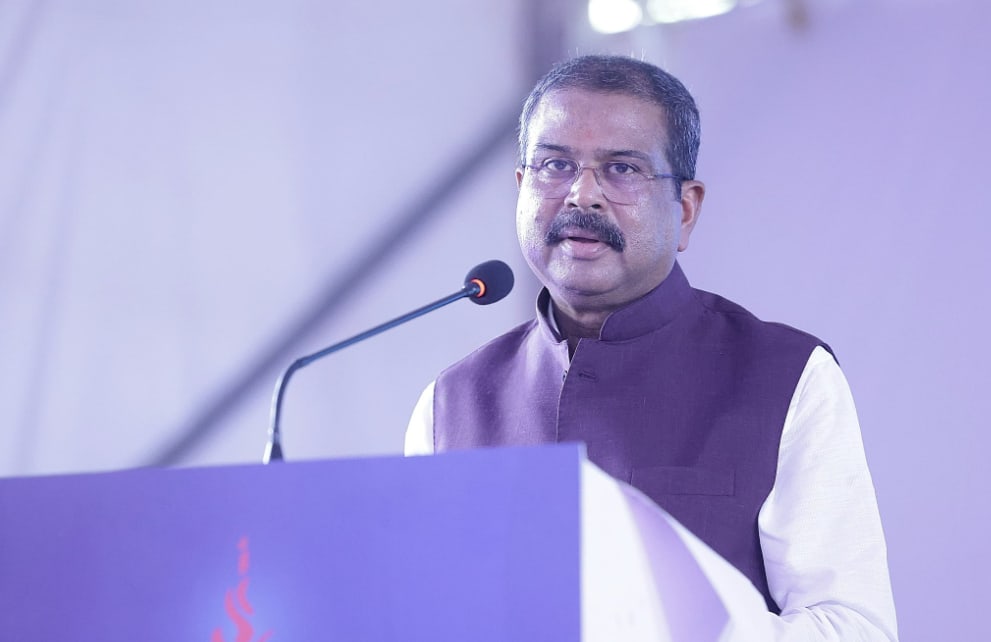
New Delhi: Dharmendra Pradhan, Minister of Education, Government of India, said that India’s education ecosystem is undergoing a transformational shift under the National Education Policy 2020, with increasing emphasis on competency, skills, innovation, and employability, during a special plenary session on education at the CII Annual Business Summit 2026 in New Delhi.
“It is time for Indian industrialists and philanthropists to build institutions for India,” he said, while appreciating CII for facilitating stronger collaboration between industry and education.
He noted that around 4 percent of India’s GDP is being spent on education, with a major share focused on strengthening school education and foundational learning through initiatives such as the NIPUN Bharat Mission.
The Minister stressed on improving learning outcomes and highlighted how skills, arts, sports, and design thinking are now becoming integral parts of mainstream education.
He emphasised that competency is becoming more important than rote subject learning and called for stronger industry participation in education, internships, and skilling initiatives.
Pradhan said students from Class 9 onwards should receive industry exposure and internships to become workforce ready, while industry must actively support and absorb young talent.
He also appreciated CII’s efforts in the education sector, including the opening of a district office in Sambalpur, and noted that the Government looks forward to deeper engagement with CII in strengthening school education and workforce development.
Sanjay Kumar, Secretary, Department of School Education & Literacy, Ministry of Education, remarked that “we are all products and outcomes of education” and added that “school education is not rocket science, but it is what makes rocket science possible.”
He described NEP 2020 as a transformational reform that changes the pedagogical structure of education and places strong emphasis on the crucial pre-primary and primary years, which are foundational for cognitive development.
He also highlighted the growing focus on computational thinking, artificial intelligence, teacher development, and the National Professional Standards for Teachers.
Anandrao V Patil, Additional Secretary, Department of Higher Education, Ministry of Education, highlighted reforms such as multidisciplinary learning, multiple entry and exit options, and the expansion of higher education in Indian languages.
He stated that the aim of these reforms is to create talent equipped with both knowledge and employable skills.
Saumya Gupta, Joint Secretary, Department of Higher Education, Ministry of Education, highlighted Bharat Innovates 2026 as a first-of-its-kind global accelerator initiative for India’s education and research ecosystem. She noted that the initiative will showcase the top 100 deep-tech innovators from Indian institutions on a global platform and described it as built by India, built for the World.
Ends.
Comments (0)
Be the first to comment!