
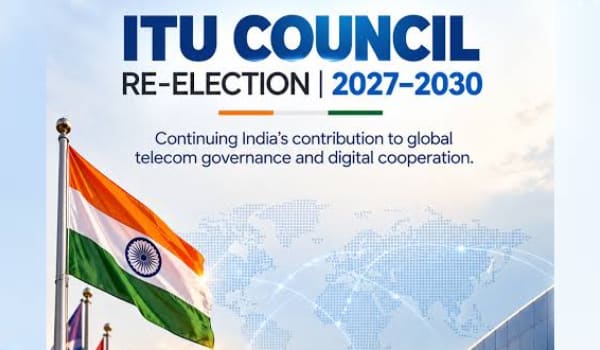
In a significant development for India's role in global telecommunications, the country has been re-elected to the International Telecommunication Union (ITU) Council for the term spanning 2027 to 2030. This re-election underscores India's growing prominence in international digital governance and its commitment to advancing global telecommunications policies.
Background on the ITU
The International Telecommunication Union, a specialized agency of the United Nations, plays a crucial role in coordinating the global telecommunications system. Established in 1865, the ITU's mandate includes setting international standards, allocating global radio spectrum, and promoting international cooperation in telecommunications.
The Council, which India is now set to be part of for another term, consists of 48 member states elected for a four-year term. This body is responsible for the administration and management of the ITU, and its members contribute to the establishment of international telecommunications policies and regulations.
Significance of India's Re-election
India's re-election to the ITU Council reflects its increasing influence in the global digital landscape. With a rapidly growing telecommunications market and a vast user base, India has become a key player in discussions around digital infrastructure, cybersecurity, and broadband access.
By securing a seat on the Council, India can advocate for policies that align with its national interests and promote the development of technology and communication services both domestically and internationally. This position also allows India to collaborate with other member states to address emerging challenges in the telecommunications sector, such as the need for better connectivity in underserved regions and the impact of new technologies.
India's Contributions to Global Telecommunications
India has made substantial contributions to the ITU and the broader telecommunications community. The country has been at the forefront of several initiatives aimed at enhancing connectivity and accessibility. India's efforts in promoting affordable internet access through programs such as Digital India and initiatives to improve rural connectivity have gained international recognition.
Moreover, India has been an advocate for multilateral cooperation in addressing global issues such as cybersecurity, spectrum management, and the digital divide. By being part of the ITU Council, India can further its agenda of fostering inclusive digital growth, ensuring that the benefits of technology reach all segments of society.
Future Outlook
As India prepares to commence its new term on the ITU Council, the country faces both opportunities and challenges. The rapid evolution of technology, along with the increasing importance of cybersecurity and data privacy, will require proactive engagement from member states.
India's participation in the ITU will be crucial in shaping policies that govern emerging technologies such as artificial intelligence, the Internet of Things (IoT), and 5G connectivity. By leveraging its expertise and resources, India aims to play a pivotal role in establishing an equitable and secure global telecommunications framework.
Comments (0)
Be the first to comment!