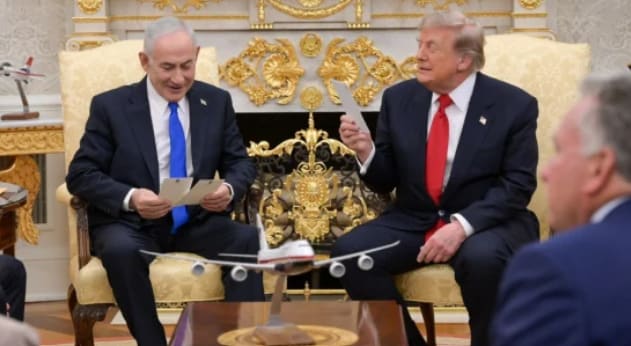
New Delhi: Israeli Prime Minister Benjamin Netanyahu’s rejection of Donald Trump’s 15-point plan for Gaza highlights just how difficult the next phase of the ceasefire negotiations could be.
Trump had presented the plan as a major breakthrough in the peace process, saying Hamas had agreed to lay down its weapons as part of a deal brokered by his “Board of Peace.” He also suggested that Israel supported the proposal.
But Netanyahu has now made clear that Israel does not accept the plan as it stands.
The central disagreement: what comes first?
At the heart of the dispute is sequencing.
Hamas has said it is prepared to lay down its weapons and hand them over for storage inside Gaza, under the supervision of a Palestinian technocratic body backed by the United States — the National Committee for the Administration of Gaza.
But Hamas has tied that move to other conditions. It wants Israel to stop its daily attacks across Gaza and withdraw from large areas of the territory.
Israel, however, is demanding the opposite sequence.
Netanyahu said Israel would not carry out any withdrawal until Hamas and its weapons had been dismantled.
In other words, Hamas wants Israeli withdrawal and an end to attacks to accompany its disarmament, while Israel wants Hamas’s complete disarmament to come first.
That difference is fundamental because neither side appears willing to make its concession before the other.
Hamas has not simply agreed to surrender its weapons
Trump’s announcement suggested that Hamas had agreed to lay down its weapons. But Hamas’s position is more conditional than that.
It has said its weapons would be handed over for storage and supervision by the proposed Palestinian administration. That body is supposed to eventually enter Gaza and take responsibility for governing the territory.
But Israel has not yet allowed the committee to enter Gaza, and it continues to operate from Cairo.
Hamas has also linked disarmament to an Israeli commitment to stop its attacks and withdraw from territory it has taken up positions in since the ceasefire began.
That makes the agreement less a straightforward surrender of Hamas’s weapons and more a conditional bargain in which both sides are expected to take steps simultaneously.
READ: Google's $15 bn data center faces environment roadblock in India: Full story
The territorial dispute is getting worse
Another major obstacle is the area controlled by Israeli forces.
When the ceasefire was announced in October last year, Israeli forces controlled roughly half of Gaza, with the boundary referred to as the Yellow Line.
Since then, according to the information provided, that line has moved deeper into Gaza and now covers more than 60% of the territory.
Hamas wants Israel to withdraw from large parts of that territory.
Israel, meanwhile, says it will not withdraw until Hamas has first dismantled its military capabilities.
That creates another version of the same sequencing problem: Israel sees withdrawal as something that should follow disarmament; Hamas sees withdrawal as part of the process that would make disarmament possible.
Israeli strikes have further undermined the negotiations
The timing of Israel’s military actions has also made the negotiations more difficult.
Hours after Hamas announced its position last week, Israel launched one of its deadliest weekends of strikes in some time.
That appeared to contradict the idea that the parties were moving toward the next phase of the ceasefire.
The strikes also drew thinly veiled criticism from Nikolai Mladenov, the Board of Peace’s High Representative for Gaza, who had met Netanyahu in Israel.
According to Reuters reporting cited in the material above, Israel indicated that it would show some restraint but would not stop all attacks.
That suggests the Trump administration has been unable to secure the kind of halt in hostilities that Hamas says it needs before moving ahead.
Netanyahu also faces domestic political constraints
There is another factor behind Netanyahu’s position: Israeli domestic politics.
Israel is preparing for an election at the end of October. That makes any decision involving Hamas, Israeli military withdrawals and Gaza particularly politically sensitive.
Trump may have considerable influence over Netanyahu, but his influence has limits when Israeli security concerns and domestic political calculations are involved.
For Netanyahu, accepting a plan that requires Israeli forces to withdraw before Hamas has completely surrendered its weapons could carry significant political risks.
His comments therefore suggest that Israel is not prepared to accept Trump's proposed sequencing simply because Washington has presented it as a breakthrough.
READ: UPI will be free, but here’s biggest worry of Payments Council of India
What Netanyahu’s rejection really means
Netanyahu’s rejection does not necessarily mean the peace process is completely dead. But it demonstrates that the two sides remain far apart on the most important practical question: what happens first?
Trump’s plan appears to depend on Hamas disarming and Israel withdrawing as interconnected steps in a broader transition.
Israel, however, insists that there can be no withdrawal until Hamas is fully dismantled and all of its weapons — from heavy weapons to smaller arms — are removed.
Hamas, meanwhile, has made its own steps conditional on an end to Israeli attacks and a substantial Israeli withdrawal.
READ: Explained: Why FCRA is at Centre of Political Debates?
So the problem is not simply whether Hamas will disarm or whether Israel will withdraw.
It is who moves first, what each side gets in return, and whether either side trusts the other to fulfill its commitments once the process begins.
That is why Netanyahu’s comments are significant. They show that, despite Trump’s declaration of a breakthrough, the next phase of the Gaza ceasefire still faces major obstacles — and that the Trump administration's ability to pressure Israel into accepting the proposed deal has clear limits.
Follow NewsEdition.in on X (Twitter) and LinkedIn for more stories on politics, the world, business, and more.
Ends.
Comments (0)
Be the first to comment!