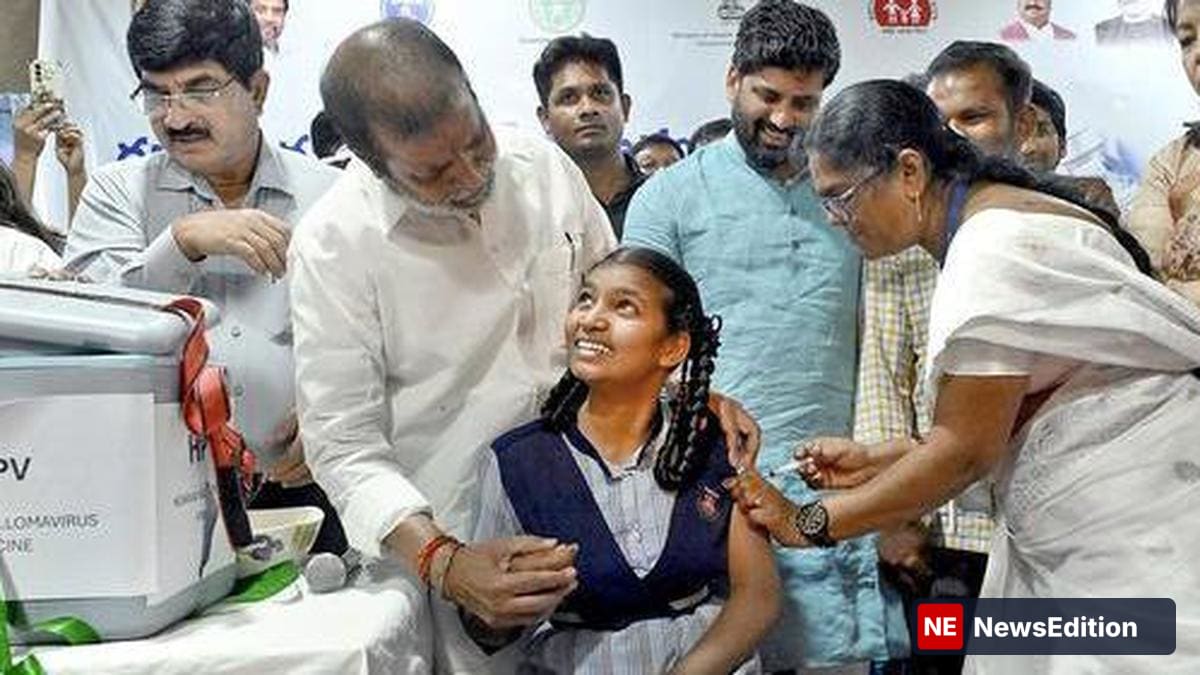
India has delivered more than one crore HPV vaccination doses to 14-year-old girls in under nine months, nearing 87% of the annual target for this age group, as reported by The Hindu citing a Union Health Ministry release.
The national campaign, which began in February 2026, aims to prevent cervical cancer by offering the human papillomavirus vaccine to adolescent girls. The Ministry stated on November 21, 2026, that the programme uses a single-dose vaccine, given free of charge at selected government health centres across the country. Receiving the vaccine is voluntary and requires parents’ approval.
Uttar Pradesh has vaccinated over 29.33 lakh girls, the highest in the country. Bihar follows with more than 13.70 lakh, and Gujarat with 7.75 lakh girls immunised. According to the Ministry, Gujarat, Uttar Pradesh, Andhra Pradesh, Mizoram, Madhya Pradesh, and Bihar have all managed to vaccinate every girl identified in their target group for this campaign.
Other states have also made substantial progress. Assam has vaccinated 95.63% of its target group, while Telangana has reached 95.28%. Karnataka stands at 93.16% and Uttarakhand at 90.17%. Chhattisgarh and Rajasthan have exceeded 80% coverage, with rates of 86.21% and 85.23% respectively. Kerala's coverage is 77.02%, Tamil Nadu's is 76.12%, Odisha's is 74.90%, and in Dadra and Nagar Haveli and Daman and Diu, 72.99% of the cohort has been vaccinated.
The government uses the U-WIN digital system to keep track of those who receive the vaccine. This platform allows parents to schedule appointments for their daughters and get digital proof of vaccination. Real-time tracking and monitoring are also possible through U-WIN, making the process more transparent and easier to follow.
The Health Ministry credited the campaign’s reach to strong cooperation between the education and health sectors. Teachers, ASHAs, ANMs, and other health workers have worked directly with families and communities to build support for the vaccine and address any doubts or worries about its safety or necessity.
What families need to know about the HPV vaccination campaign
This campaign means most 14-year-old girls in India now have the opportunity to receive the HPV vaccine at no cost. It is only available at government facilities, and parents must give their consent. The vaccination sessions are supervised by medical staff, and arrangements are in place to respond to any immediate health concerns that might arise after the shot.
Participation rates vary from state to state. While some have vaccinated every girl in their identified group, others are still working towards full participation. The Ministry’s figures show a strong push nationwide to protect this age group from cervical cancer, but the rollout is not yet complete everywhere.
Analysis: what the campaign’s progress suggests
- Using the U-WIN digital platform appears to make it easier for parents to access the vaccination process and keep records, which could be helping boost participation.
- The complete coverage reported in six states could indicate that local engagement and coordination between schools and health workers have been especially effective there, compared to places with lower rates.
- The reports do not specify whether future rounds will include other age groups or what challenges remain in the states where coverage is below the national target, so the next steps for expanding or adjusting the campaign remain unclear.
What comes next for the HPV vaccination effort
The Union Health Ministry has not detailed any upcoming changes or new phases for the campaign. Efforts remain focused on increasing participation in states that have not yet met their targets and maintaining high coverage where targets have already been reached.
Comments (0)
Be the first to comment!