
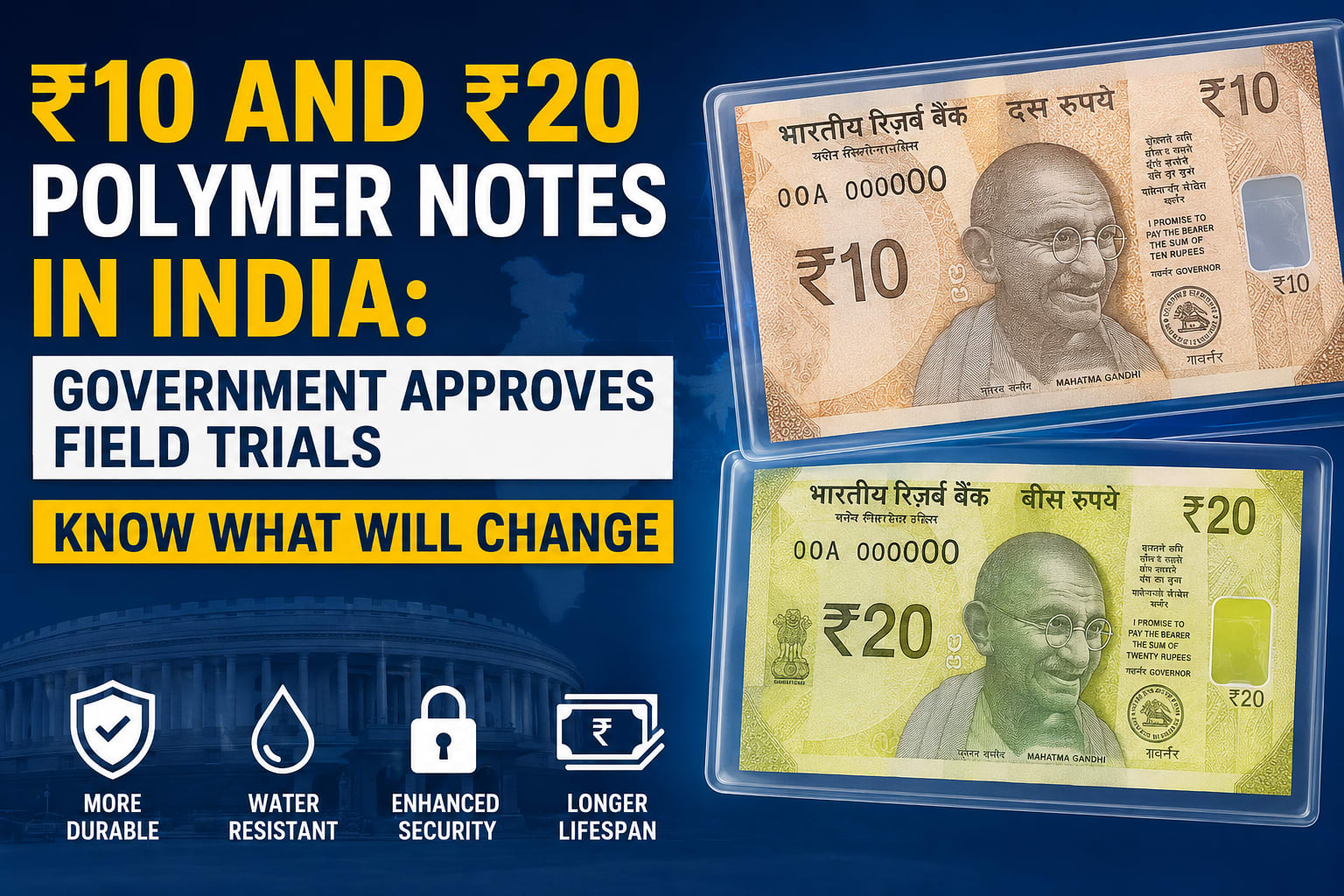
India may soon witness a major change in the way some low-denomination currency notes are made. The Central Government has approved the Reserve Bank of India's proposal to conduct field trials of polymer banknotes in ₹10 and ₹20 denominations.
The development has attracted considerable attention because polymer currency is different from the traditional paper-based banknotes currently used across the country. Polymer notes are made from a durable plastic-like substrate and are designed to withstand moisture, dirt and repeated handling better than conventional paper notes.
However, one important point needs to be clarified: the approval is for field trials, not for an immediate replacement of all existing ₹10 and ₹20 paper notes. Existing currency will continue to remain valid.
According to reports, the Reserve Bank of India has proposed trials involving one billion ₹10 polymer notes and one billion ₹20 polymer notes. The trial will allow authorities to evaluate the performance, durability, security and practical use of polymer currency in India's cash ecosystem.
What Are Polymer Banknotes?
Polymer banknotes are currency notes manufactured using a special polymer substrate instead of conventional cotton-based paper.
Unlike ordinary paper currency, polymer notes have a smooth and flexible texture. Their material makes them more resistant to water, dirt and physical wear.
Countries including Australia, Canada, the United Kingdom and New Zealand have already used polymer banknotes in different denominations. The technology is therefore not new globally, but its large-scale adoption in India would represent a significant development for the country's currency system.
The main idea behind polymer currency is simple: make banknotes last longer while improving security and reducing the frequency with which damaged notes need to be replaced.
Government Approves ₹10 and ₹20 Polymer Note Field Trials
The latest decision concerns only the trial phase.
The government has approved the RBI's proposal to introduce polymer banknotes in the ₹10 and ₹20 denominations for field testing. The proposal involves one billion pieces of each denomination.
The RBI has also moved ahead with the procurement process for polymer substrate material. Reports indicate that a global Expression of Interest was floated for the manufacture and supply of polymer substrate sheets, with the bidding process forming part of preparations for the proposed trials.
This means consumers should not expect an overnight change in their wallets. The trial needs to be completed and evaluated before any decision regarding wider circulation can be taken.
Will Paper ₹10 and ₹20 Notes Stop Being Valid?
No.
The approval of polymer notes does not mean that existing paper currency will suddenly become invalid.
The proposed polymer notes are expected to be tested alongside existing paper banknotes. There is currently no indication that all paper-based ₹10 and ₹20 notes will be withdrawn immediately.
This distinction is important because social media discussions around "plastic currency" can sometimes create confusion about whether old notes will stop working.
For consumers, the practical message is straightforward: existing valid ₹10 and ₹20 banknotes can continue to be used normally.
Any future decision to change the status of existing currency would require an official announcement from the competent authorities.
Why Is India Considering Polymer Currency?
There are several reasons why polymer banknotes are being considered.
1. Longer Life
One of the biggest advantages of polymer banknotes is their durability.
Low-denomination notes are handled extremely frequently. They move between consumers, shops, transport operators, banks and businesses many times during their circulation.
As a result, small-value notes can become dirty, torn or damaged relatively quickly.
Polymer material is designed to withstand repeated handling better than conventional paper currency.
2. Better Resistance to Water and Dirt
Paper notes can be damaged by moisture and water. Polymer notes are considerably more resistant to such exposure.
This could be particularly useful in a country such as India, where currency notes are frequently used in outdoor markets, public transport, small retail businesses and other high-contact environments.
The material can also make the notes easier to clean and maintain.
3. Improved Security
Another major reason for exploring polymer currency is security.
Polymer banknotes can incorporate specialised security features, including transparent or clear sections and other elements that are difficult to reproduce using ordinary printing methods.
These features can make counterfeiting more challenging.
However, the exact security configuration of India's proposed trial notes will depend on the RBI's final design and specifications.
4. Reduced Replacement Frequency
When a currency note becomes too damaged or soiled, it eventually has to be removed from circulation and replaced.
If polymer notes survive longer in everyday use, the RBI and the banking system could potentially reduce the frequency with which certain denominations need to be replaced.
This is one of the key economic arguments behind testing durable banknote materials.
What Could Change for Common People?
For ordinary consumers, the biggest difference could simply be the look and feel of the note.
Polymer banknotes generally feel different from traditional paper currency. They can also have a smoother surface and may appear more durable.
If the ₹10 and ₹20 polymer notes enter circulation after successful trials, people could gradually start receiving both paper and polymer versions of these denominations.
At shops, markets, petrol stations, public transport counters and other cash-heavy locations, consumers may eventually encounter both types of notes.
However, this transition would not necessarily happen immediately or uniformly across India.
The trial is intended to help authorities understand exactly how polymer currency performs under Indian conditions.
Will Polymer Notes Be More Expensive to Produce?
This is another important question.
Polymer banknotes can have higher initial production costs compared with conventional paper notes. However, their longer lifespan can potentially offset part of the additional manufacturing cost.
Therefore, authorities need to consider the total lifecycle cost, rather than simply comparing the price of producing one polymer note with one paper note.
The field trial can provide useful information about durability, circulation life, maintenance and replacement requirements.
Only after analysing these factors can policymakers determine whether wider adoption makes financial sense.
India Has Considered Polymer Notes Before
Interestingly, the idea of polymer currency is not completely new for India.
The country had previously explored polymer banknotes, including trials and discussions around their potential use. However, the initiative did not progress to widespread circulation.
The current proposal therefore represents a renewed attempt to evaluate whether advances in technology and currency-security systems make polymer notes more suitable for India today.
The latest field trials could provide authorities with an opportunity to test the technology on a much larger scale than earlier efforts.
What Happens After the Field Trial?
The approval of the field trial is only the first step.
Several factors will have to be evaluated before a broader rollout can happen.
Authorities are likely to assess:
Durability of polymer notes
Public acceptance
Performance in different weather conditions
Resistance to dirt and moisture
Security and anti-counterfeiting features
Printing and production requirements
Compatibility with currency-handling machines
Banking and ATM processing
Overall lifecycle cost
Ease of handling by consumers and businesses
If the results are satisfactory, the government and RBI could consider expanding polymer currency to wider circulation.
However, there is currently no confirmed nationwide date for the complete introduction of polymer ₹10 and ₹20 notes.
Will ATMs and Cash Machines Need Changes?
The introduction of polymer banknotes could also have implications for cash-handling infrastructure.
Banks, ATMs, cash-counting machines and currency-processing systems are designed around specific characteristics of banknotes.
If polymer notes have differences in thickness, flexibility or surface properties, machines may need to be tested for compatibility.
This is another reason why a controlled field trial is important.
Instead of immediately introducing billions of new notes across the country, authorities can evaluate how the notes interact with India's existing cash infrastructure.
Are Polymer Notes Better Than Paper Notes?
There is no simple answer.
Polymer notes have clear advantages in terms of durability, water resistance and certain security features. But paper currency also has an established manufacturing, handling and recycling ecosystem.
The success of polymer currency depends on whether its benefits outweigh the additional production, processing and infrastructure requirements.
That is precisely what the field trial is expected to help determine.
What Should People Do With Existing ₹10 and ₹20 Notes?
Nothing special.
There is no need for the public to exchange existing ₹10 or ₹20 notes simply because polymer currency trials have been approved.
Existing valid notes remain usable.
Consumers should also be cautious about social media claims suggesting that old ₹10 or ₹20 notes will suddenly become invalid. Currency-related changes should always be verified through official announcements from the RBI or Government of India.
Bottom Line
The approval of polymer ₹10 and ₹20 banknote trials marks an important experiment in India's currency system.
The objective is not to immediately eliminate paper money but to determine whether polymer currency can provide longer-lasting, more secure and more durable low-denomination banknotes.
The proposed trial of one billion ₹10 polymer notes and one billion ₹20 polymer notes will give authorities valuable information about how the technology performs in real-world Indian conditions.
For now, consumers can continue using existing ₹10 and ₹20 notes normally. The real question is what happens after the field trial: if polymer notes prove cost-effective, secure and convenient, India could eventually see a wider transition toward polymer currency.
In other words, India is testing the future of its small-denomination cash — but the paper ₹10 and ₹20 notes are not disappearing overnight.
Read Also: https://newsedition.in/article/us-judge-dismisses-criminal-charges-against-gautam-adani-key-details
Read Also: https://newsedition.in/article/how-msme-development-bill-will-help-small-businesses-full-detail
Read Also: https://newsedition.in/article/how-much-pm-modis-foreign-trips-cost-taxpayers-in-last-5-years
Comments (0)
Be the first to comment!