
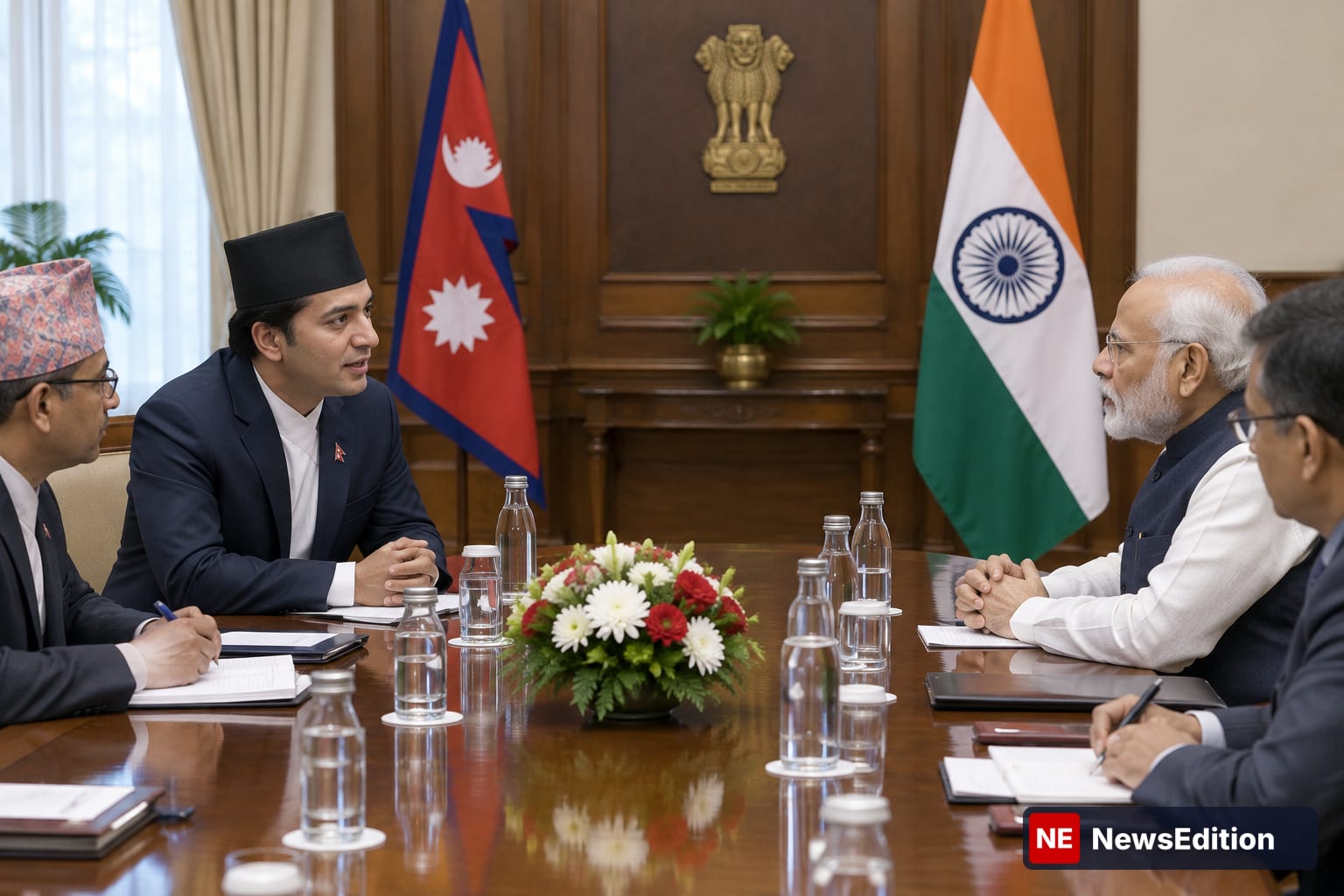
Nepal Prime Minister Balendra Shah has begun his first official trip to India since taking office, aiming to strengthen economic cooperation and secure support for disaster recovery, BBC News reports. His meetings in Delhi mark the first major engagement between Nepal’s younger political leadership and Indian officials after Shah’s Rastriya Swatantra Party won the March elections.
Shah, 36, arrived in the Indian capital on Sunday for a two-day programme. During the visit, he is scheduled to meet Indian Prime Minister Narendra Modi as well as other senior leaders. The agenda includes discussion of economic and energy partnerships, the possibility of opening additional air routes, and seeking Indian help for rebuilding efforts after the August floods that struck Nepal. More than 1,450 people died in those floods, and thousands are still missing, leaving Nepal with a reconstruction bill that the government says could reach $5 billion.
The two countries are linked by a 1,750km open border and share deep social, religious, and economic connections. India is Nepal’s main supplier of petroleum and several key food items, and also acts as the primary route for Nepali trade with the world. However, ties have repeatedly been tested by disputes over territory and by claims in Kathmandu that Delhi uses its size and influence to dominate Nepalese affairs.
Shah’s rise follows a wave of youth-led protest against corruption and nepotism, which forced out the previous government led by K P Sharma Oli. The new administration has emphasised its willingness to focus on “development, diplomacy and economic partnership,” according to former Indian ambassador to Nepal Ranjit Rae, who told the BBC that Nepal’s new leaders “do not have the political baggage of the past.”
One major topic for the current visit is cooperation in electricity. India has agreed to purchase up to 1,200MW of power from Nepal, and also enables Nepal to send electricity to Bangladesh through Indian territory. Nepal hopes to expand these arrangements further, making use of its significant water resources and mountainous geography.
Bilateral trade is valued at over $9 billion, with Nepal importing far more from India than it exports. This imbalance has long been a source of frustration in Kathmandu. Nepal is also requesting that India allow new air entry points for large aircraft to access its airports at Bhairahawa and Pokhara, which would reduce flight times and costs. These airports were built with Chinese assistance, and some Nepalese observers believe this may make Delhi cautious about granting the request.
Despite their close links, the countries have unresolved issues. Tensions rose in 2019 after India released a map that included land claimed by Nepal near the border with China. Nepal responded by publishing its own map that showed the disputed areas as part of its territory. Kanak Mani Dixit, a Nepalese political analyst, told the BBC he hopes Shah will bring up the border dispute in Delhi, even if no quick solution is likely.
Shah's trip comes at a time when his government faces criticism at home over recent decisions, such as removing the police chief and actions against journalists. Some observers in Nepal, quoted by the BBC, argue that Shah and his team lack experience in handling diplomacy with a powerful neighbour like India. Still, many see this visit as a chance to move beyond past friction and secure results that could ease domestic pressure on Shah’s administration.
Analysis: how Shah’s visit could shape Nepal-India relations
- The arrival of a new, younger leadership in Nepal signals a possible departure from the contentious politics of the past, which could open the door for more practical cooperation between the two countries.
- Shah’s urgent need for reconstruction aid after the August floods means that the outcome of this visit is likely to be measured in concrete economic or financial commitments rather than diplomatic symbolism.
- The BBC report notes concerns about Shah’s experience and preparation, suggesting that his ability to secure major agreements could be limited by his government’s inexperience in international negotiations.
What happens next in Delhi and Kathmandu
Shah’s meetings in Delhi are set to conclude on Monday, with any pledges of aid or new agreements expected to be announced afterward. The scale and terms of Indian support for Nepal’s reconstruction remain to be seen, as does whether any progress will be made on issues like air routes or border talks.
Comments (0)
Be the first to comment!