
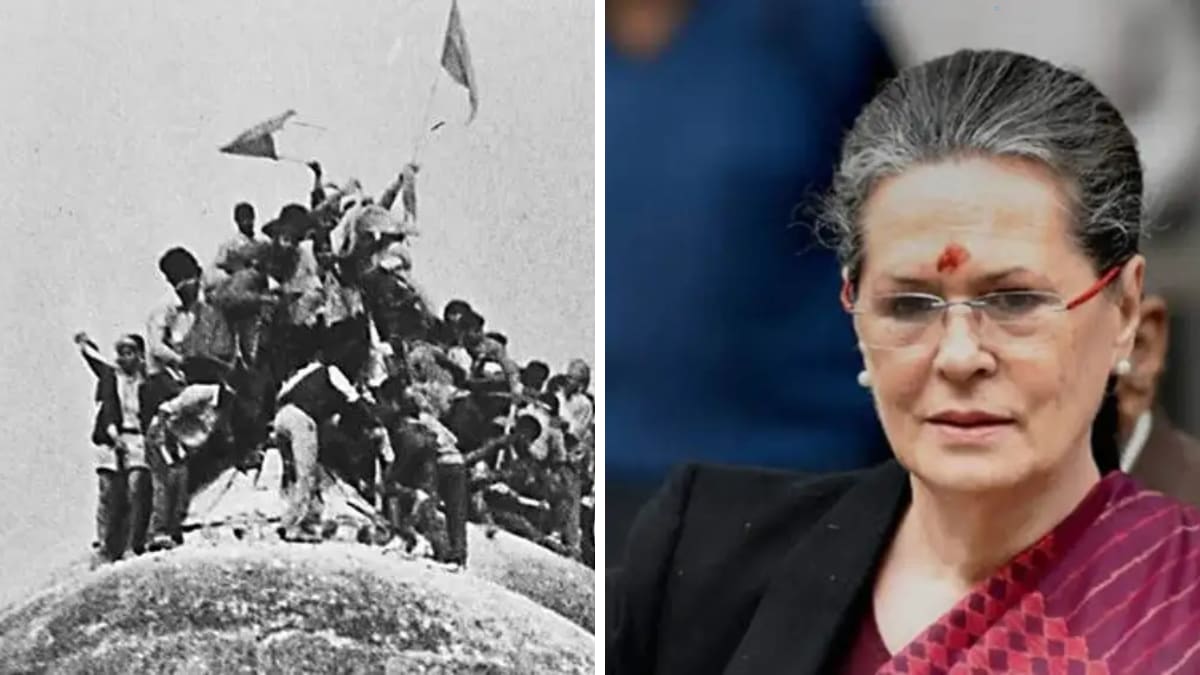
The Bharatiya Janata Party (BJP) has reacted strongly to Congress leader Sonia Gandhi's recent comments concerning the Babri Masjid demolition, asserting that her statements reflect the Congress party's purported anti-Ram sentiments. This exchange has reignited the long-standing debate surrounding the contentious issue of the Babri Masjid and the Ram Janmabhoomi site in Ayodhya, which has been a focal point of religious and political tensions in India.
Background on the Babri Masjid Controversy
The Babri Masjid, originally built in the 16th century, was demolished in December 1992 by a large group of Hindu activists who claimed it was built on the birthplace of Lord Ram. This event led to widespread communal riots across the country and has since been a significant factor in Indian politics, particularly influencing the rise of the BJP.
The Supreme Court of India delivered a landmark verdict in November 2019, allowing the construction of a Ram temple at the disputed site, while also directing the allocation of alternative land for a mosque. This ruling was celebrated by many Hindu groups but criticized by others, who viewed it as a setback for secularism in India.
Sonia Gandhi's Statements
During a recent political rally, Sonia Gandhi made remarks that the BJP interpreted as a dismissal of the Ram Janmabhoomi movement and its significance to Hindu devotees. Although the exact phrasing of her statements has been a point of contention, BJP leaders argue that her comments reveal a fundamental disconnect between the Congress party and the beliefs of the Hindu community.
BJP's Response
In response to Gandhi's remarks, the BJP has launched a campaign to highlight what they describe as the Congress party's historical antagonism towards Hindu sentiments. BJP spokespersons have emphasized that the party stands firmly with Hindu devotees and their beliefs, contrasting this with what they label as the Congress's secular but, in their view, anti-Hindu stance.
The BJP's narrative is designed to galvanize their voter base, particularly in light of upcoming elections where religious sentiments often play a crucial role in voter decisions. The party's leaders are framing the Congress's stance as out of touch with the values and aspirations of the Hindu majority in India.
Political Implications
The exchange between the BJP and Congress over the Babri Masjid illustrates the deep-rooted divisions in Indian politics, particularly regarding religious identity. The BJP has often capitalized on Hindu nationalism as a unifying theme for its electoral campaigns, while the Congress has aimed to position itself as a proponent of secularism and pluralism.
With general elections approaching, the BJP's focus on religious issues, particularly associated with Lord Ram and the Babri Masjid, is likely to intensify. Political analysts suggest that these discussions may sway undecided voters who feel strongly about religious identity and its role in public life.
Comments (0)
Be the first to comment!