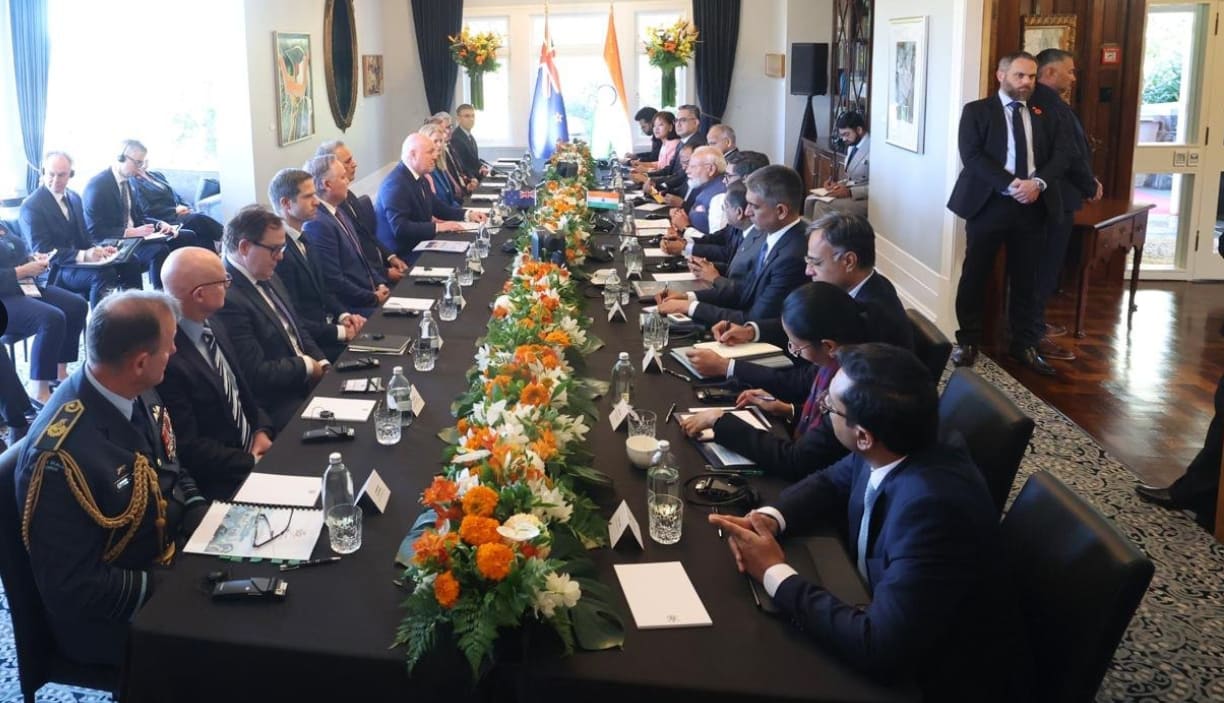
Auckland [New Zealand]: Prime Minister Narendra Modi during his official visit to New Zealand encouraged businesses to expand investment and commercial partnerships and help realize the target of doubling bilateral trade to NZD 7 billion (approximately Rs 35,000 crore) by 2030.
He emphasized that India-New Zealand economic partnership could become a model for inclusive and sustainable trade and a platform for innovation and prosperity.
PM Modi, along with the Prime Minister of New Zealand, Christopher Luxon, today interacted with a select group of CEOs and business leaders.
Prime Minister Modi highlighted that India and New Zealand are bound by shared democratic values, respect for the rule of law, diversity, and a common commitment to sustainable development, providing a strong foundation for an ambitious and forward-looking economic partnership.
He described the India-New Zealand Free Trade Agreement as a landmark that would add depth and dynamism to the bilateral economic ties, and open new opportunities for market access, investment, services, technology and talent mobility.
READ: Explained: If E20 fuel damages your vehicle, who pays?
Prime Minister Modi underscored that India's sustained high growth coupled with young and skilled workforce, expanding middle class, digital revolution, next-generation infrastructure push, and continuing economic reforms, offer significant opportunities for trade, investment, and innovation for companies in New Zealand.
He noted that political stability and sustained growth path has positioned India as a significant contributor to global growth.
He invited New Zealand investors and business houses to partner India in infrastructure development, civil aviation, logistics, clean energy, urban mobility, water management, waste management and digital economy sectors.
Speaking about India’s vibrant start-up ecosystem, he called for closer engagement between the private sectors of both countries in the fields of innovation, fintech and emerging technologies.
He noted that New Zealand's strengths in dairy science, horticulture, and forestry, and India’s consumer market, food parks and agri-tech talent should come together to create global food value chains.
READ: Why INS Mahendragiri is India's most powerful indigenous stealth warship yet
Follow NewsEdition.in on X (Twitter), LinkedIn for more stories on Politics, World, Business and more.
Ends.
Comments (0)
Be the first to comment!