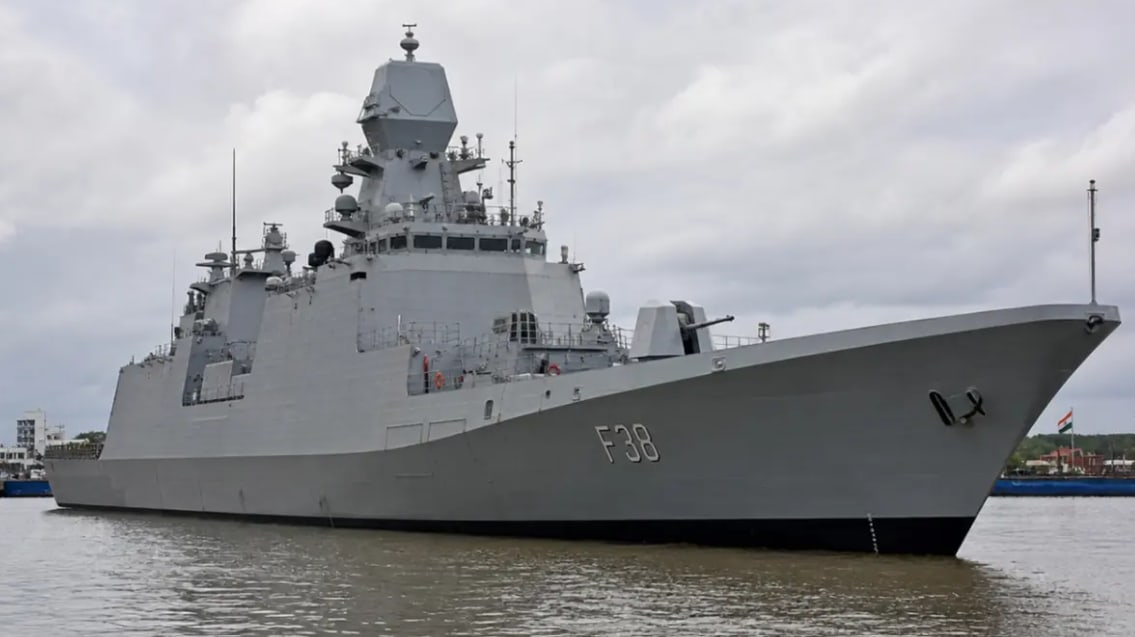
New Delhi [India]: The Indian Navy is set to commission INS Mahendragiri, the sixth and final stealth frigate under the Project 17A Nilgiri-class programme, at the Eastern Naval Command in Visakhapatnam on July 11.
The induction marks another milestone in India's indigenous warship-building programme, with the vessel built using nearly 75% indigenous content under the government's Atmanirbhar Bharat initiative.
The commissioning ceremony will be attended by Defence Minister Rajnath Singh, senior naval officials, representatives of Mazagon Dock Shipbuilders Limited, and several MSMEs that contributed to the project.
Built in India, Designed by the Navy
INS Mahendragiri has been designed by the Indian Navy's Warship Design Bureau and constructed by Mazagon Dock Shipbuilders Limited in Mumbai. It is the final vessel of the Project 17A programme, which succeeds the earlier Project 17 Shivalik-class frigates with enhanced stealth features, greater automation and more advanced combat systems.
The warship is named after Mahendragiri, a prominent peak in the Eastern Ghats of Odisha.
Following commissioning, the frigate will become part of the Indian Navy's Eastern Fleet and begin operational deployment, including crew training and integration with surface and aerial assets in the Bay of Bengal and the wider Indian Ocean Region.
READ: Explained: If E20 fuel damages your vehicle, who pays?
Advanced Stealth and Multi-Role Combat Capability
INS Mahendragiri is a 149-metre-long, 6,670-tonne guided missile stealth frigate capable of operating across air, surface and undersea warfare domains.
The vessel can achieve speeds of nearly 28 knots and has an operational range exceeding 5,000 nautical miles at cruising speed. It is powered by a Combined Diesel or Gas (CODOG) propulsion system comprising diesel engines and LM2500 gas turbines.
One of the ship's defining features is its advanced stealth design. The hull and superstructure incorporate stealth shaping and specialised materials that significantly reduce radar, infrared, acoustic and electromagnetic signatures, making the vessel harder to detect.
Equipped with BrahMos and Barak-8 Missiles
The frigate is equipped with several advanced weapon systems and sensors, including:
32 Barak-8 long-range surface-to-air missiles for air defence.
Eight BrahMos supersonic cruise missiles for anti-ship and land-attack missions.
A 76 mm main gun.
AK-630 close-in weapon system.
RBU-6000 anti-submarine rocket launchers.
Heavyweight torpedoes.
Capacity to operate up to two anti-submarine warfare helicopters.
Its sensor suite includes the MF-STAR AESA multifunction radar, Lanza surface search radar and Humsa NG sonar, all integrated through the CMS-17A combat management system.
Strengthening India's Naval Capabilities
According to the Ministry of Defence, the commissioning of INS Mahendragiri represents another major milestone in the successful execution of Project 17A.
As more Nilgiri-class frigates join the fleet, they are expected to significantly enhance the Indian Navy's operational capabilities while reinforcing India's position as a leading indigenous warship-building nation.
The induction comes as the Navy continues its modernisation drive. Earlier this year, three frontline naval platforms were commissioned simultaneously, reflecting India's focus on expanding maritime capabilities amid evolving security challenges in the Indian Ocean Region.
With its advanced stealth features, long-range strike capability and multi-dimensional warfare systems, INS Mahendragiri is expected to serve as a key escort for carrier battle groups, protect critical sea lanes and strengthen India's maritime security architecture in the Indo-Pacific.
READ: ICAI renews recognition deal with CPA Australia
Follow NewsEdition.in on X (Twitter), LinkedIn for more stories on Politics, World, Business and more.
Ends.
Comments (0)
Be the first to comment!