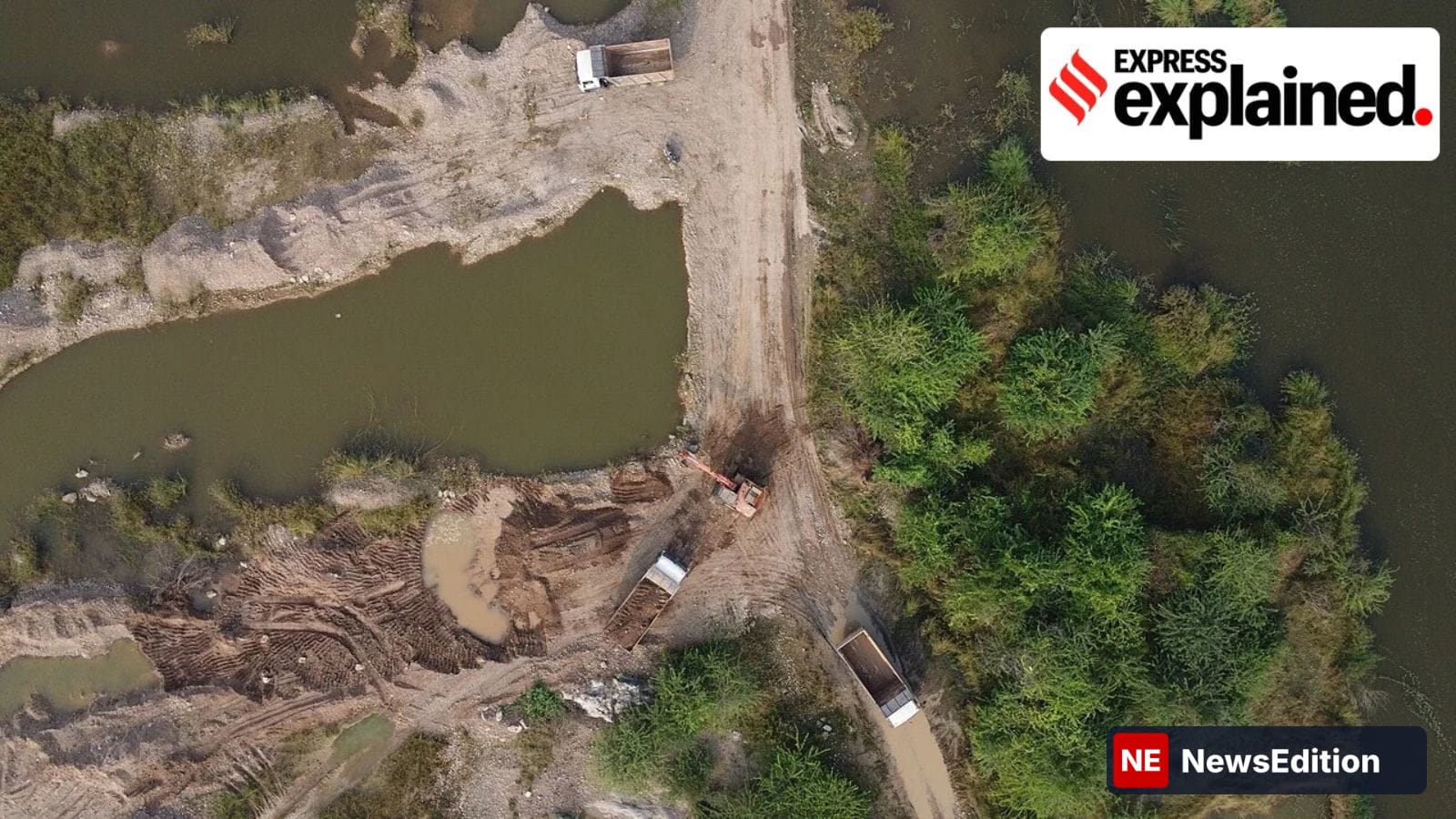
The Supreme Court’s Central Empowered Committee (CEC) has recommended a three-year plan to phase out unsustainable riverbed sand mining across India, aiming to protect river ecosystems and infrastructure while urging the use of sediment collected from dam reservoirs instead, according to The Indian Express.
The CEC presented these proposals to the Supreme Court as part of a suo motu case that began with concerns about illegal sand mining in the National Chambal Sanctuary. In October, the Supreme Court broadened the scope of the matter, asking the CEC to provide a comprehensive report about sand extraction from riverbeds nationwide.
The CEC’s main position is that the removal of sand from rivers at current rates is harming the environment and causing reservoirs to lose their ability to store water, as sediment builds up behind dams. The committee advised the court that a national policy is needed to recover sediment from reservoirs and use it as a substitute for construction sand, responding to the rising demand for building materials as infrastructure projects expand across the country. The Supreme Court has not yet given its final ruling on these suggestions.
How the recommendations change sand mining and dam management
The CEC views rivers as complex natural systems that need a steady exchange of water and carried sediments such as sand, gravel, and silt. These materials help keep riverbeds stable, recharge groundwater, and support aquatic life. The committee warned that digging too deeply into riverbeds for sand can break the underground layers that separate groundwater from the river, leading to water loss from wells and aquifers nearby.
While the CEC differentiates between limited, surface-level sand removal after the monsoon and large-scale, deep excavation, it argues that repeated failures in enforcement and the damage caused by excessive mining require a shift away from extracting sand from active river channels. The committee also pointed to the destruction of habitats and the increased risk to infrastructure. It cited the 2010 order by the Bombay High Court that stopped the use of suction pumps to mine sand from the Vaitarna River, due to threats to a railway bridge, and the 2024 incident where excessive extraction contributed to damage of the Kalwa-Nangal bridge over the Swan River in Punjab.
Instead, the committee suggests that sediment collected by desilting dams and reservoirs could serve as an alternative source for construction needs. Over time, dams trap large amounts of silt and sand, which reduces their storage abilities and affects uses like irrigation and electricity generation. The CEC highlighted official data showing that, among 74 major reservoirs, the average capacity loss due to sedimentation was 24%. In detail, 23 reservoirs had lost more than half of their initial storage, another 23 saw losses between 40% and 50%, and 49 reservoirs lost between 30% and 40% of their capacity. For example, the Gobind Sagar reservoir behind the Bhakra Dam has seen its capacity drop from 9,868 million cubic metres to around 7,300 million cubic metres—a decline of roughly 26%.
The Bhakra Beas Management Board estimated that each year, Bhakra receives 35 to 40 million cubic metres of new sediment, while Pong reservoir gets about 25 million cubic metres. However, the CEC cautioned that only some of this material is suitable for construction, as it must be tested for grain size, mineral content, and quality. Finer particles like clay and silt may not be useful, but sand and gravel could have commercial value. The committee also stressed the need to consider impacts on water quality, aquatic life, and dam safety when removing sediment.
To implement this approach, the CEC proposed a national policy for managing sediment in reservoirs, including a ten-year cycle for desilting, individual assessments for each dam, proper testing, environmental protections, and clear rules for using the recovered materials. Dams older than 15 years that have not been desilted systematically should be given priority for this work.
Enforcement problems were another major concern. The committee listed issues such as outdated local survey reports, unclear boundaries for mining sites, old replenishment studies, mining beyond allowed limits, operations at night, and forged transport permits. It emphasized that even valid leases and environmental approvals do not guarantee that mining is done within legal boundaries. The CEC referred to Ministry of Mines records that counted 95,306 cases of illegal mining involving both major and minor minerals for the year 2021-22, though these numbers do not specify sand alone. There is no single national record of either legal sand production or illegal extraction, which the committee sees as a significant gap in governance.
Analysis: what the proposed shift means for sand supply and oversight
- This move could signal a major reduction in riverbed sand supply for builders, pushing more reliance on sediment recovered from dams, provided it passes quality checks.
- The lack of centralised data and persistent illegal mining suggest that switching to dam sediment is not just about ecology but also about improving oversight and enforcement.
- Introducing regular desilting cycles and stricter policies may require dam operators and construction suppliers to adapt, but the timeline and specific implementation steps remain to be determined by authorities.
Next steps: what to expect from the Supreme Court and policymakers
The Supreme Court is expected to review the CEC’s recommendations in detail in the near future. The committee has also advised central agencies to create a national policy for sediment management and to begin assessments of older dams that have not yet been systematically desilted.
Comments (0)
Be the first to comment!