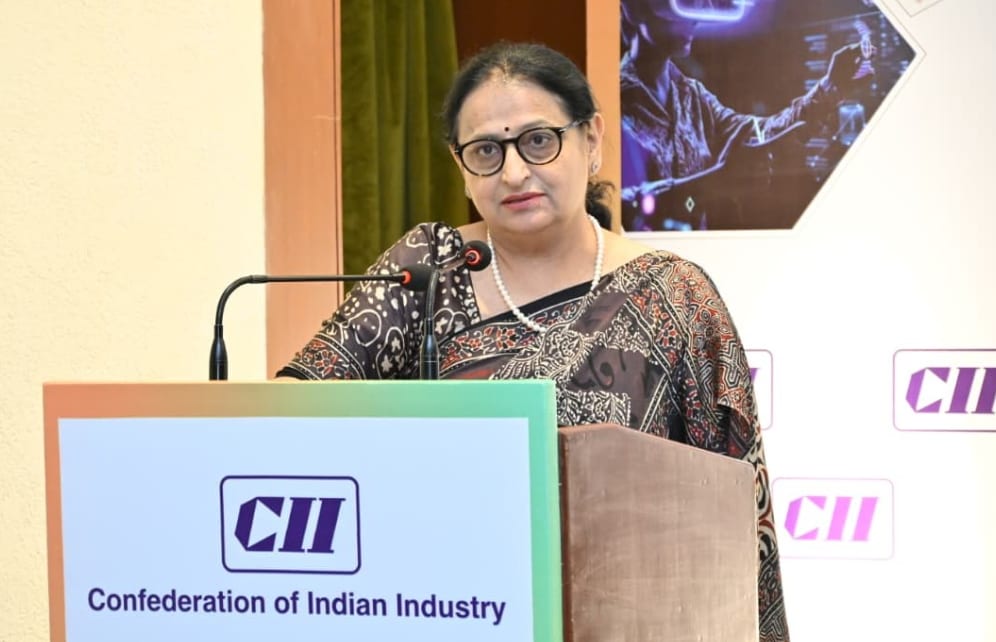
New Delhi: Women leadership is not just a social objective but also an economic and strategic imperative for India, said Dr Parvinder Maini, Scientific Secretary, Office of the Principal Scientific Advisor to the Government of India.
Speaking at an event organised by industry body Confederation of Indian Industry (CII), Maini said, "Women are transformational leaders, not just transactional participants in the lab. When women lead, they don't just participate in the ecosystem, they change the culture of the ecosystem. Inclusive innovation is no more a choice, it is a social objective, but also an economic and strategic imperative for India, ensuring that the benefits of science, technology, and innovation reach everybody alike, while simultaneously strengthening the country's resilience, competitiveness."
As India accelerates towards becoming a global technology leader, the full and meaningful participation of women in science, technology, engineering, and mathematics has emerged as both a strategic imperative and an untapped competitive advantage.
The CII convened the Women in STEM Leadership Summit under the theme 'Powering Inclusive Innovation for India's Technology Future', bringing together industry leaders, policymakers, researchers, entrepreneurs, and international partners to advance a long-term, outcome-oriented agenda for women in STEM.
Maini further emphasised the business case for inclusion: "When companies create flexible, dynamic pathways to executive leadership, they don't just help women — they secure a massive competitive advantage for themselves and for the nation."
"In India, 43% of students in STEM are women — that's quite remarkable; in Germany, it's 38%. Gender balance in STEM should be on the agenda of everybody. We have more than 500 partnerships between academic and research institutions between our two countries — and there are 60,000 Indian students in Germany, many of them women in STEM," said Dr Philipp Ackermann, German Ambassador to India and Bhutan.
"Women all over are helping build technologies that protect the nation and improve lives. In artificial intelligence, women are ensuring that AI becomes not only intelligent, but also ethical and socially impactful. Women are strengthening innovation all over while mentoring future scientists and engineers. This comes as a natural trait to women because they keep doing it unconsciously, unknowingly, in their day-to-day life," said Dr. Chandrika Kaushik, Distinguished Scientist & Director General, Defence Research and Development Organization (DRDO), Government of India
"Women make up 43% of STEM graduates in India — a significant number compared to any major economy in the world. However, when it hits the workforce, the number gets reduced to only 27%. Is it a talent gap? Definitely not. It's a system story. We built the pipeline, but now we have to create a culture to sustain it," said Soni Kaul, Principal Expert, Anusandhan National Research Foundation (ANRF).
READ: SpaceX crash wipes out $1.5 trillion in 6 weeks
"When I was looking for the offering behind Chandrayaan 3, I found the names of six women at ISRO who made Chandrayaan 3 happen. One week ago, India and a private company launched Skyroot — and here again, we are the women in space. We are the girls who looked at the stars and found our destiny. We are the voice of New India — the voice of passion, perseverance, and determination," said Candace Johnson, Founder/Co-Founder SES, Loral Teleport Europe, Europe Online, and Chair, Seraphim Space.
"Almost 50% or more of our research scholars in doctorate programs are women — very encouraging compared to many economies. However, at every stage in leadership, women representation divides. Women still remain underrepresented as vice chancellors, directors of research institutes, founders of deep tech organisations, patent holders, even on boards and as CEOs. The challenge is no longer one of access to talent — it is equally one of transition, retention, and long-term development," said Swati Mor, Head - Human Resources, Renew IPP.
READ: India's billionaire income club surges 300% in 5 years
Summit Launches
The summit witnessed launch of two landmark initiatives:
1. CII Women in STEM Compendium 2026 — A comprehensive reference document mapping women's participation and leadership in STEM across India.
2. National Charter for Women in STEM — Signed at the summit, the Charter represents a formal, industry-wide commitment to building an inclusive STEM ecosystem, with measurable, accountable outcomes across hiring, retention, leadership development, and entrepreneurial support.
The summit was attended by 300+ delegates spanning industry leaders, researchers, policymakers, entrepreneurs, academics, and international partners — reflecting India's growing resolve to place inclusive innovation at the heart of its technology future.
Follow NewsEdition.in on X (Twitter) and LinkedIn for more stories on politics, the world, business, and more.
Ends.
Comments (0)
Be the first to comment!