
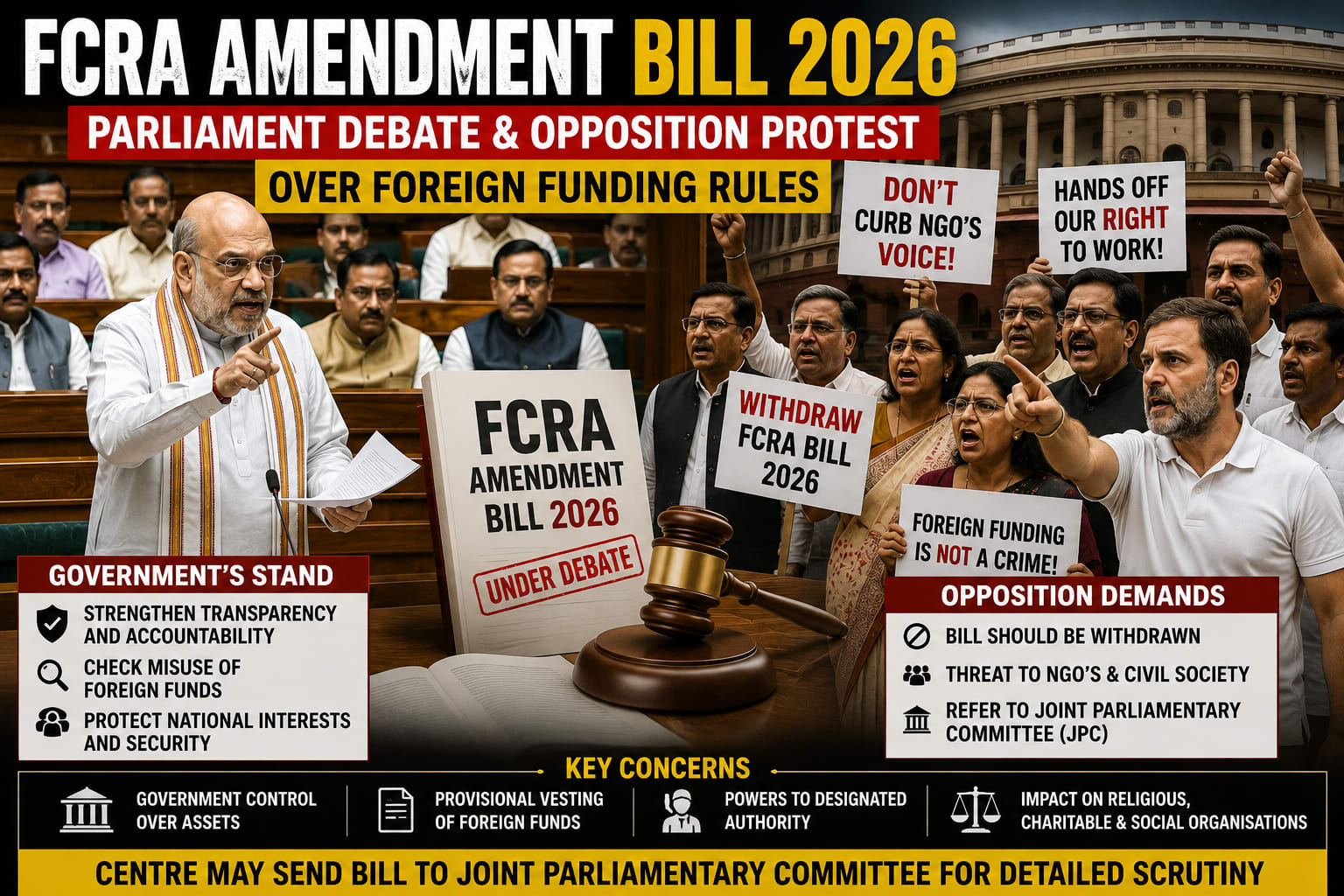
India's proposed FCRA Amendment Bill 2026 has become a major political flashpoint during the ongoing Monsoon Session of Parliament, with the Centre considering sending the legislation to a Joint Parliamentary Committee (JPC) for detailed scrutiny.
The possible move comes amid strong opposition from several political parties and concerns raised by organisations, particularly in parts of the Northeast. The government is looking for broader consensus on the proposed changes, while Opposition parties have demanded either significant changes or complete withdrawal of the Bill.
The legislation seeks to amend the Foreign Contribution (Regulation) Act, 2010, which governs the acceptance and utilisation of foreign contributions by individuals, associations and organisations in India.
At the centre of the controversy is a proposed framework for dealing with foreign-funded assets when an organisation's FCRA registration ends, is cancelled, surrendered or is not renewed.
The Bill was introduced in the Lok Sabha on March 25, 2026, and remains under parliamentary consideration.
What Is the FCRA Amendment Bill 2026?
The Foreign Contribution (Regulation) Amendment Bill, 2026 proposes changes to India's existing foreign funding framework.
The FCRA regulates donations, funds and other contributions received from foreign sources. The law applies to various organisations and entities that receive foreign contributions for permitted activities.
The government says the proposed amendments are intended to close gaps in the existing legal framework and improve transparency, accountability and management of assets created through foreign contributions.
One of the most significant proposals is the creation of a Designated Authority that would supervise, manage and potentially dispose of foreign-funded assets in certain circumstances.
According to PRS Legislative Research, the Bill provides a framework for dealing with foreign contributions and assets when an organisation ceases to hold a valid FCRA certificate.
Why Is the Centre Considering a JPC?
The possibility of sending the Bill to a JPC comes after growing political resistance and concerns from stakeholders.
A Joint Parliamentary Committee consists of members from both Houses of Parliament and is formed to examine a particular Bill or issue in greater detail.
Referral to a JPC would give MPs additional time to study the proposed provisions, hear representations and examine possible legal, administrative and practical consequences.
Recent reports indicate that the Centre is attempting to build consensus around the JPC route rather than immediately pushing the legislation through Parliament.
For the government, a JPC could provide an opportunity to address concerns without abandoning the Bill's broader objectives.
For the Opposition, however, the question remains whether sending the Bill to a committee is enough or whether the legislation should be withdrawn altogether.
Read Also: https://newsedition.in/article/how-much-pm-modis-foreign-trips-cost-taxpayers-in-last-5-years
What Does the Bill Propose Regarding NGO Assets?
The issue of assets created from foreign contributions is one of the most important provisions of the proposed legislation.
Under the proposed framework, when an organisation's FCRA registration ceases, its foreign contributions and assets created from such funds could come under the supervision of a Designated Authority.
The Bill provides for provisional vesting of assets. If the organisation manages to restore or renew its registration within the prescribed period, its assets and unused foreign contributions can be returned.
However, if registration is not restored within the prescribed period, the Bill provides for permanent vesting under specified circumstances.
This provision has become a major source of concern among critics.
Read Also: https://newsedition.in/article/rajnath-singh-chairs-meeting-on-territorial-army-key-talks-here
Why Are Opposition Parties Protesting?
Opposition parties have raised concerns about the extent of government powers under the proposed amendments.
Critics argue that the provisions concerning the control and management of assets could have a significant impact on NGOs, charitable organisations and institutions that depend on foreign contributions for their activities.
The Congress has reportedly demanded complete withdrawal of the Bill, while other Opposition parties have taken different positions, including support for referral to a JPC.
The disagreement has therefore created a complex political situation in Parliament.
While some parties want the Bill withdrawn, others are open to detailed parliamentary scrutiny before a final decision is taken.
Why Has the Bill Become Sensitive in the Northeast?
The proposed FCRA changes have attracted particular attention in the Northeastern states, including Mizoram and Nagaland.
Church organisations and other groups in Mizoram have publicly expressed concerns over the potential impact of the proposed legislation on religious institutions, NGOs and assets associated with foreign contributions.
Reports indicate that organisations in the region have called for the Bill to be examined by a Joint Parliamentary Committee.
The issue has consequently acquired a regional as well as national political dimension.
Mizoram Chief Minister Lalduhoma has also been involved in discussions with Union Home Minister Amit Shah regarding concerns around the proposed FCRA changes. The Centre has reportedly assured him that the amended provisions would not be applied retrospectively.
Government's Stand on the FCRA Bill
The government maintains that the proposed changes are aimed at improving governance and addressing gaps in the existing FCRA framework.
The Centre has argued that foreign contributions need to be properly monitored because they can have implications for transparency, accountability and public interest.
The government has also emphasised that the proposed system is not designed to arbitrarily take over the assets of organisations.
According to the government's explanation, provisional vesting would allow assets to be protected while the organisation's FCRA status is resolved. If registration is restored, the assets and unused funds can be returned.
The government has also highlighted proposed safeguards, including avenues for revision and judicial appeal against orders issued by the designated authority.
What Happens to Assets if FCRA Registration Is Restored?
This is an important aspect of the proposed system.
The Bill provides that provisional vesting would not automatically mean permanent loss of an organisation's assets.
If the organisation successfully restores its FCRA registration within the prescribed period, the foreign contributions and assets covered by the provision would be returned.
Permanent vesting would apply only if the registration is not restored within the specified period and other conditions set out in the legislation are met.
This distinction has been emphasised by the government while responding to criticism surrounding the proposed asset provisions.
Read Also: https://newsedition.in/article/netflixs-co-ceo-meets-modi-discusses-india-plans
What Is a Designated Authority Under the Bill?
The proposed Designated Authority would play a central role in managing foreign-funded assets in cases where an organisation loses its FCRA status.
Its responsibilities would include supervision, management and disposal of assets covered by the proposed provisions.
The Bill also proposes mechanisms for review and judicial appeal.
According to the government, these provisions are intended to provide a structured legal process rather than leaving asset management to administrative uncertainty.
However, critics are expected to examine how much discretion the authority would receive and what safeguards would be available to organisations affected by its decisions.
These questions could become important if the Bill is referred to a JPC.
Proposed Changes to Penalties
Another notable feature of the FCRA Amendment Bill concerns penalties.
The Bill proposes to reduce the maximum imprisonment for violations of the FCRA from five years to one year.
At first glance, this represents a reduction in the maximum prison term. However, Opposition parties and civil society groups are also examining the broader enforcement powers proposed by the legislation.
The government describes the changes as part of a broader effort to rationalise the legal framework.
Read Also: https://newsedition.in/article/centre-deploys-response-team-for-chandipura-virus-outbreak
What About State-Level Investigations?
The proposed legislation also deals with coordination between central and state agencies in FCRA-related investigations.
According to the government's explanation, state agencies would need approval from the Central Government before initiating certain FCRA investigations.
The government argues that such coordination would help avoid overlapping investigations and provide a more consistent enforcement framework.
Critics, however, may question whether greater central control could reduce the role of state agencies.
This is another area that could receive attention if the Bill goes before a JPC.
FCRA Rules 2026 Have Already Changed
The controversy surrounding the Bill comes alongside changes to the FCRA Rules, 2026.
The revised rules were notified on June 22, 2026 and are already in force, according to the Ministry of Home Affairs' explanation.
One change requires FCRA registration certificates to specify the exact purposes and the States or Union Territories in which an organisation intends to operate, selected from a prescribed schedule.
The government says these changes are administrative and governance-focused.
However, organisations receiving foreign contributions will need to carefully understand the updated compliance requirements.
Will the FCRA Bill Affect NGOs?
If passed in its proposed form, the Bill could have important implications for NGOs and other organisations receiving foreign contributions.
Organisations may need to pay closer attention to:
FCRA registration validity
Renewal deadlines
Management of foreign-funded assets
Documentation and compliance
Permitted use of foreign contributions
Reporting requirements
Legal proceedings involving FCRA registration
For organisations with significant foreign-funded assets, the proposed rules concerning registration cessation could be particularly important.
However, the final impact will depend on the version of the legislation ultimately passed by Parliament.
What Could Happen if the Bill Goes to a JPC?
If the government formally refers the Bill to a Joint Parliamentary Committee, the legislation could undergo a more detailed examination.
The JPC could study the provisions, invite representations, examine concerns raised by political parties and stakeholders, and recommend changes.
The committee's recommendations could influence the final version of the legislation, although the parliamentary process would continue after the committee submits its report.
A JPC referral would therefore not mean that the Bill has been rejected.
It would mean that Parliament has chosen to examine the legislation in greater detail before deciding its future.
Why the JPC Decision Matters Politically
The FCRA Bill has become more than a technical amendment to an existing law.
It is now part of a broader political confrontation between the government and Opposition during the Monsoon Session.
For the government, a JPC referral could demonstrate willingness to consider concerns while preserving the core objective of strengthening FCRA governance.
For the Opposition, committee scrutiny could provide an opportunity to challenge provisions it considers excessive and seek amendments.
The final outcome could therefore depend heavily on negotiations between the government and different Opposition parties.
What Should NGOs and Citizens Know Right Now?
The most important point is that the FCRA Amendment Bill 2026 is still a proposed law.
It should not be treated as though all its proposed provisions are already in force.
The existing FCRA framework continues to govern foreign contributions, while the revised FCRA Rules notified in June 2026 are separately applicable.
Any organisation receiving foreign contributions should therefore distinguish between provisions already notified and changes that remain part of the pending Bill.
Conclusion
The FCRA Amendment Bill 2026 has emerged as one of the most contentious pieces of legislation before Parliament during the Monsoon Session.
The Centre is considering sending the Bill to a Joint Parliamentary Committee amid Opposition resistance and concerns raised by organisations in several parts of the country.
At the heart of the debate are provisions dealing with foreign-funded assets, FCRA registration, the proposed Designated Authority, investigation procedures and penalties.
The government says the Bill will strengthen transparency, accountability and legal clarity, while critics fear that some provisions could give the Centre excessive control over organisations receiving foreign contributions.
A JPC referral could provide both sides with additional space to examine the legislation.
For now, the Bill remains under parliamentary consideration, and its final shape could change significantly depending on the committee process and political negotiations.
The next major question is whether the government and Opposition can reach a consensus on the JPC route—or whether the demand for complete withdrawal will continue to dominate the Parliament debate.
Comments (0)
Be the first to comment!