
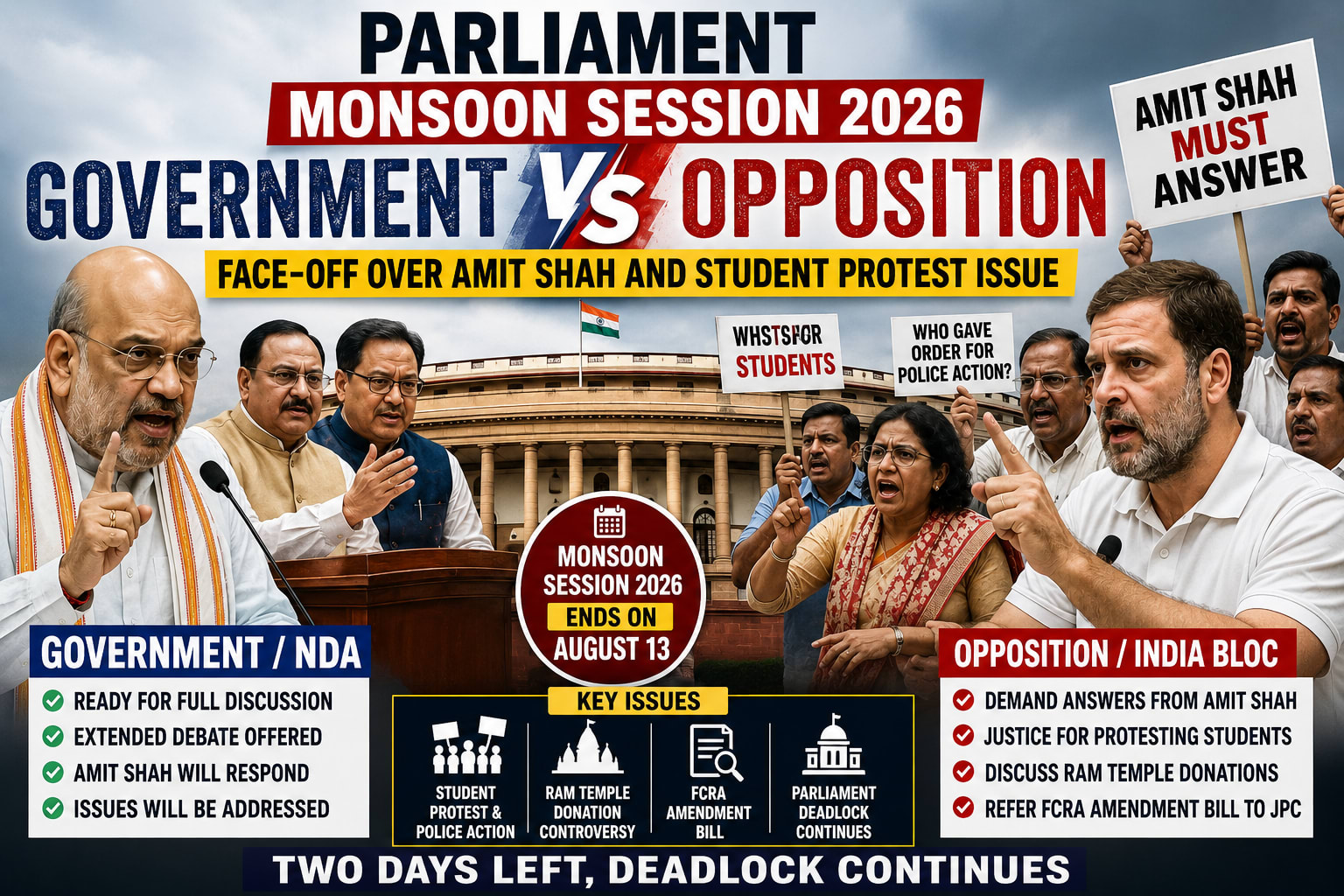
India's Parliament Monsoon Session 2026 has entered a critical final phase, but the political deadlock between the government and the Opposition continues to dominate proceedings.
With the session scheduled to conclude on August 13, only two working days remain, increasing pressure on both sides to find a way forward. The government has offered a detailed discussion on the student protests and police action that triggered the confrontation, while the Opposition continues to demand direct answers from Union Home Minister Amit Shah and has maintained that several of its demands are non-negotiable.
The latest development has shifted the political battle from a simple demand for an Amit Shah statement to a larger disagreement over how the issue should be discussed in Parliament, what questions should be answered and which other issues must be taken up before the House can function normally.
Government Offers Full Debate Instead of Just Amit Shah Statement
Parliamentary Affairs Minister Kiren Rijiju said on August 11 that the government was prepared to go beyond a formal statement by the Home Minister and hold a full-fledged discussion on the student protest issue.
According to Rijiju, the government was ready for an extended debate, potentially lasting an entire day or even two days, during which the government would respond to the Opposition's questions. He also claimed that Home Minister Amit Shah was prepared to respond.
The government argues that a detailed debate would allow all aspects of the student protest and subsequent police action to be examined rather than limiting the proceedings to a statement from the Home Minister.
This proposal is being presented by the government as an attempt to break the prolonged parliamentary stalemate.
However, the Opposition has not accepted the government's approach as sufficient.
Why Is the Opposition Demanding Amit Shah's Response?
The current Parliament deadlock has its roots in the July 20 student protest in Delhi.
Opposition parties have raised questions about the police action against students who participated in a 'Sansad Chalo' march. The protest was connected to demands surrounding alleged examination paper leaks and calls for accountability.
According to reports, several students and police personnel were injured during the confrontation. The issue intensified after videos and images circulated showing protesters with injuries that the Opposition said required further investigation.
The Opposition subsequently demanded that Home Minister Amit Shah address Parliament and clarify the circumstances surrounding the police action.
Congress leader and Leader of Opposition Rahul Gandhi has particularly focused on the question of who authorised the use of force against the protesting students.
For the Opposition, therefore, the issue is not simply whether Amit Shah will deliver a speech. It wants specific answers regarding responsibility and decision-making during the July 20 incident.
Read Also: https://newsedition.in/article/how-much-pm-modis-foreign-trips-cost-taxpayers-in-last-5-years
Rahul Gandhi Says Specific Answers Are Needed
Rahul Gandhi has argued that the Opposition is not seeking a general political speech from the Home Minister.
His stated demand is for clarity over the police action against students, particularly whether Amit Shah personally authorised the firing or use of force.
The government, meanwhile, has accused Rahul Gandhi and Congress of avoiding a parliamentary discussion despite its offer to debate the matter.
Rijiju said the government was prepared to answer questions point by point and urged the Opposition to participate in the proposed discussion.
This disagreement has become one of the central political confrontations of the Monsoon Session.
Three Major Issues Are Driving the Parliament Standoff
The current deadlock is not limited to the student protest issue.
Three major political issues have emerged as important points of disagreement.
1. Student Protest and Police Action
The first and most immediate issue is the police action during the July 20 student protest.
The Opposition wants the Home Minister to address questions about the incident and accountability.
The government says it is ready for a detailed discussion and wants the issue examined comprehensively.
2. Ram Temple Donation Controversy
The second issue concerns allegations surrounding donations to the Ram Temple in Ayodhya.
Rahul Gandhi has demanded accountability over the alleged misuse or theft of temple donations and has also called for Prime Minister Narendra Modi to address the matter.
The government has reportedly indicated that it is willing to allow a discussion on the issue, although it wants the discussion to follow debates on other matters.
The issue is politically sensitive because the Ram Temple occupies an important place in the BJP's political narrative, while Uttar Pradesh is heading toward another important electoral cycle.
3. FCRA Amendment Bill
The third major issue is the proposed amendment to the Foreign Contribution Regulation Act (FCRA).
The legislation has generated disagreement among opposition parties as well as between the Opposition and the government.
The government has reportedly offered to send the proposed FCRA legislation to a Joint Parliamentary Committee (JPC) for detailed examination.
A JPC review could provide an avenue for further discussion, but it has not yet resolved the larger political impasse.
Opposition Parties Are Not Completely United on FCRA Bill
Interestingly, the Opposition's position on the FCRA Bill is not entirely uniform.
The Congress has demanded that the legislation be withdrawn.
The Trinamool Congress has reportedly shifted its position, initially favouring referral to a JPC before subsequently calling for withdrawal.
The DMK has indicated that it could accept either withdrawal or referral to a JPC, while the Biju Janata Dal has supported sending the legislation to a JPC.
This division could become important in the final days of the Monsoon Session.
The government may attempt to use areas of agreement among individual opposition parties to move forward on some legislative business.
Read Also: http://newsedition.in/article/railways-fines-caterers-513-cr-terminates-6-contracts-heres-why
Parliament Continues to Function Amid Protests
Although the confrontation has disrupted proceedings, Parliament has not been completely inactive.
On August 11, the Lok Sabha passed the Kerala (Alteration of Name) Bill, 2026, which seeks to change the state's official name from Kerala to Keralam.
The Bill was passed by voice vote without a detailed debate as Opposition MPs continued protesting over the demand for Amit Shah's presence in the House.
The development highlights the unusual situation inside Parliament: some legislative measures are moving ahead, but prolonged protests have prevented normal debate on several major political issues.
Why the Final Two Days Matter
The Monsoon Session is scheduled to conclude on August 13.
That leaves very little time for the government and Opposition to resolve their differences.
The government is keen to demonstrate that Parliament can return to normal functioning and that important legislative business can be completed.
The Opposition, on the other hand, wants the government to address what it considers serious questions surrounding the student protests and other controversies.
The final two days could therefore see intense negotiations, protests and attempts to reach political compromises.
Government vs Opposition: What Is at Stake?
The confrontation is larger than one statement by one minister.
For the government, allowing a detailed discussion could provide an opportunity to present its version of events and challenge Opposition allegations.
For the Opposition, forcing the government to answer questions in Parliament is an important way to demand political accountability.
The battle also has a wider political dimension.
With several politically sensitive issues on the table, both the ruling NDA and Opposition parties have an interest in shaping the public narrative before upcoming electoral contests.
Could the Parliament Deadlock End?
There is still a possibility of a breakthrough.
The government's willingness to hold a detailed debate on the student protests represents a potential opening.
Its reported willingness to consider a JPC examination of the FCRA Bill and allow discussion on the Ram Temple donation controversy also indicates that the government is attempting to negotiate on several fronts.
However, the Opposition's demand for specific accountability over the July 20 police action remains a major obstacle.
The question is whether both sides can agree on the format, sequence and scope of the discussions.
If they do, the remaining days could see Parliament returning to substantive legislative business.
If they fail, the session could end with significant political confrontation and limited legislative productivity.
What Happens Next?
The immediate focus will be on whether the Opposition accepts the government's proposal for a detailed debate on student protests.
If the debate takes place, Amit Shah could face questions from Opposition MPs on the July 20 incident and the government's handling of the situation.
At the same time, discussions around the FCRA Bill, Ram Temple donations and other pending legislative matters could determine whether Parliament sees a last-minute political breakthrough.
The coming hours are therefore likely to remain politically significant.
Read Also: https://newsedition.in/article/us-judge-dismisses-criminal-charges-against-gautam-adani-key-details
Conclusion
The Parliament Monsoon Session 2026 has reached a decisive stage, with the government and Opposition still divided over how to address the student protest controversy and several other contentious issues.
The government has now offered something broader than the statement initially sought by the Opposition: a detailed parliamentary discussion in which the Home Minister could respond to questions.
The Opposition, however, continues to insist that the central issue is accountability for the July 20 police action and wants specific answers rather than a general political response.
At the same time, the Ram Temple donation controversy and FCRA Amendment Bill have added further complexity to negotiations.
With the session ending on August 13, the next two days could determine whether the government and Opposition finally find common ground—or whether the Monsoon Session ends amid continued protests and political confrontation.
Comments (0)
Be the first to comment!