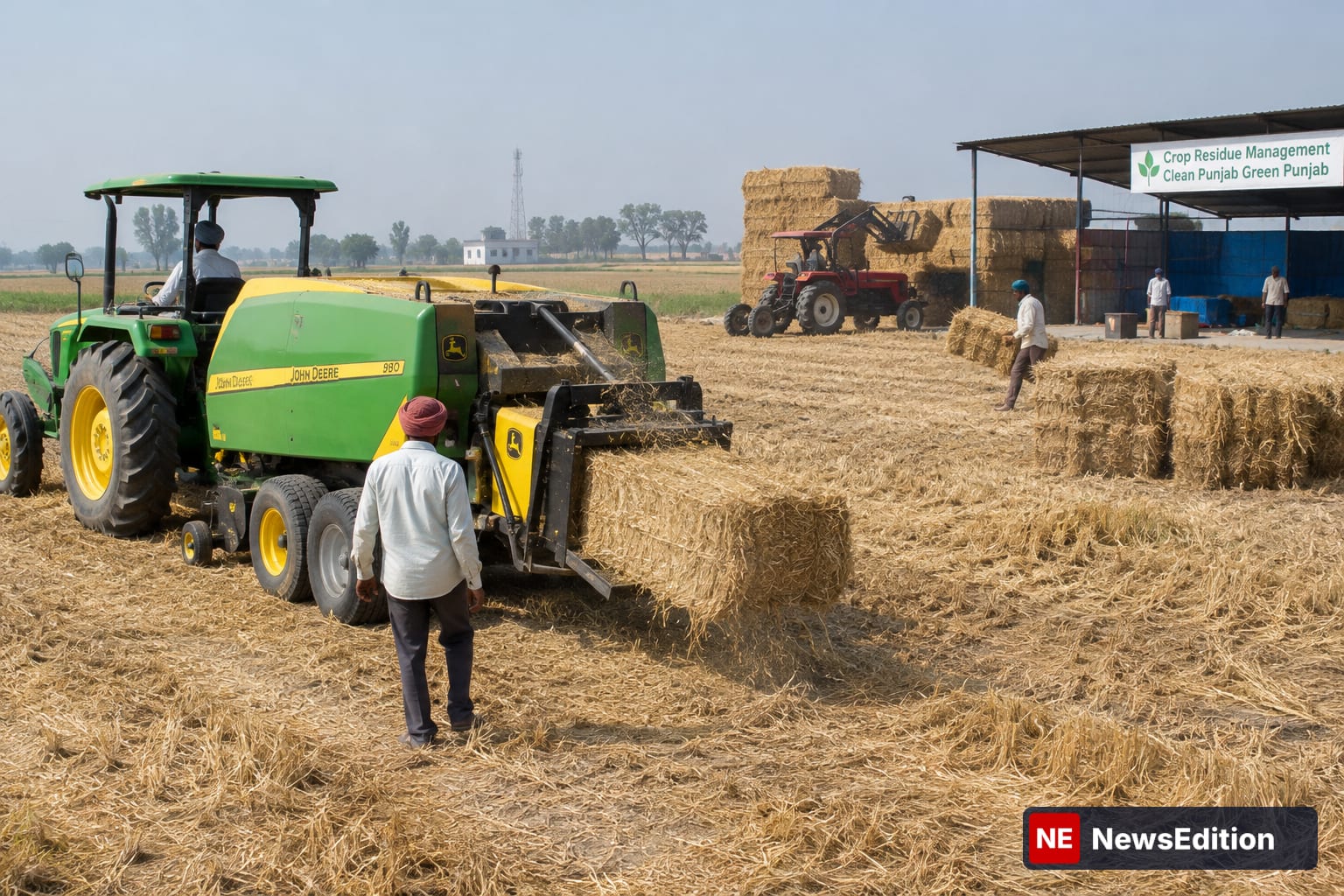
Punjab and Haryana have not achieved their paddy straw utilisation targets for this harvest season, despite adding more crop residue management equipment and infrastructure. This shortfall affects efforts to reduce stubble burning and improve winter air quality, NDTV reports.
Both states set annual goals for using paddy straw, aiming to convert it into products or transport it for industrial purposes. These targets are part of a wider push to prevent farmers from burning leftover straw in fields, which contributes to air pollution. The most recent progress figures were published in the State Action Plan-2026 Report Card by the Commission for Air Quality Management, as cited by NDTV.
Where Punjab and Haryana Stand on Paddy Straw Utilisation
Punjab processed 11.68 lakh tonnes of paddy straw into pellets and briquettes by 31 October. This is just over half of its yearly goal of 22.03 lakh tonnes, meaning it reached 53 percent of its target. Haryana managed to convert 6.89 lakh tonnes, or 35 percent of its 19.66 lakh tonne target. Both states were rated as performing below expectations in this area.
Pellets and briquettes refer to compact blocks or cylinders produced by pressing together agricultural leftovers like paddy straw. Industries, power plants, and boilers use them as substitutes for coal, turning agricultural waste into a source of energy instead of a pollution problem. The aim is to give farmers a way to dispose of straw that does not involve burning it in their fields.
Looking at the movement of straw away from farms for use elsewhere—known as ex-situ utilisation—the numbers also fall short. Punjab managed to handle 54.62 lakh tonnes out of a planned 78.07 lakh tonnes, or 70 percent of its target. Haryana moved 15.54 lakh tonnes, which is 57 percent of its 27.10 lakh tonne goal. To reach their yearly goals, Punjab still needs to handle another 23.45 lakh tonnes through ex-situ means, while Haryana is short by 11.56 lakh tonnes.
Machinery and Storage: Expansion But Gaps Remain
The report suggests that Punjab, with its larger pool of working Crop Residue Management (CRM) machines, has made more progress than Haryana, though both states are behind on key targets. Punjab has 19,890 working CRM machines, the highest among the four states covered in the review. Haryana reports 13,700 such machines.
Even with these numbers, Punjab has not yet reached its own goal of 22,500 machines, standing at 88 percent of the target. In contrast, Haryana has more than met its machine goal, deploying 13,700 units against a target of 9,000. Rajasthan and Uttar Pradesh have also surpassed their targets, with Rajasthan at 1,253 machines (goal: 1,203) and Uttar Pradesh at 234 (goal: 203).
On the storage front, Haryana has stored paddy straw bales on 823 hectares, far beyond its 109-hectare target. Punjab has reached 860.5 hectares out of a planned 1,016.76 hectares, or 85 percent. For paddy straw management plants, Haryana is just one short of its 52-plant goal, at 51, while Punjab has 44 plants in operation out of a target of 72.
The figures highlight a persistent challenge: despite more machines and expanded storage, actual use of paddy straw for energy and industry has not kept pace with capacity, especially in turning straw into pellets and briquettes.
Analysis: What the Shortfall Reveals About Paddy Straw Utilisation
- The expansion of machinery and storage facilities has not translated into full use of available paddy straw, suggesting that other barriers—such as logistics, participation by farmers, or demand from industry—may be limiting progress.
- Punjab's larger fleet of machines has not resulted in proportional gains in straw utilisation, which could indicate that simply having more equipment is not enough to resolve bottlenecks in the system.
- The reports do not explain why pellet and briquette output remains low despite infrastructure growth, raising questions about market conditions, policy incentives, or coordination between different actors.
What Comes Next for Paddy Straw Management
With the paddy harvesting season drawing to a close, officials in both states will await the end-of-season review to measure final progress. The next update is expected after the season ends, when authorities will assess whether new measures are needed to meet future paddy straw utilisation and air quality goals.
Comments (0)
Be the first to comment!