
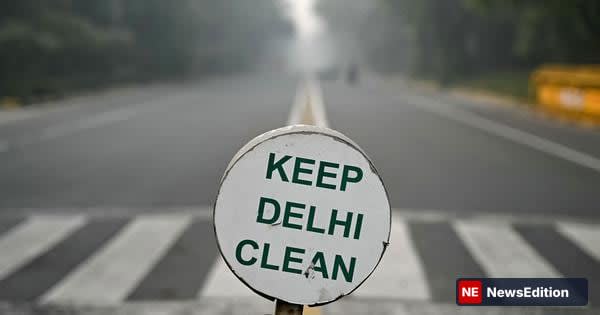
Air pollution continues to plague the National Capital Region, revealing deep flaws in how the area is governed and planned, as administrative boundaries expand but environmental problems remain unsolved, according to Scroll.in.
The NCR was formed in 1985, following the NCR Planning Board Act, when Delhi’s urban growth began spilling over into neighbouring states. The region originally spanned around 30,000 square kilometres, covering Delhi and parts of Haryana, Uttar Pradesh, and Rajasthan. Over the years, the NCR’s territory has nearly doubled to more than 55,000 square kilometres, and officials are considering further changes to its borders.
This expansion was intended to manage the pressures of jobs, housing, and industry that now extend across state lines. Commuters, workers, and businesses often move freely between cities like Delhi, Gurugram, and Noida. Yet, the environmental challenges—especially air pollution—do not respect these administrative divisions. People living anywhere from central Delhi to the outskirts in towns like Karnal or Bharatpur are affected by air quality that is shaped by factors far beyond local government control.
How the current system operates—and where it breaks down
While the NCR map has grown on paper, the reality is that the geography of pollution, water, and forests often ignores state lines. Environmental systems such as airsheds, river basins, and aquifers do not match the boundaries set by governments. Scroll.in points out that the Yamuna River, for example, flows without regard for which authority oversees each stretch.
To address the widespread nature of air pollution, the central government established the Commission for Air Quality Management in 2021. This body was given the authority to oversee pollution issues across the entire Delhi-NCR region, recognising that the area where pollutants build up—the airshed—extends well beyond any single city's limits. The commission was designed to issue orders, review compliance, and coordinate responses that affect multiple states and agencies.
However, in January, the commission conducted a review of how well anti-pollution measures under the Graded Response Action Plan were being followed during periods of poor air quality. These measures, which escalate as pollution worsens, include stopping heavy trucks from entering the region, closing industries that are not essential, pausing construction activities, shifting to remote work, and shutting schools.
The commission’s assessment found that required actions had not been fully carried out, with implementation rates ranging from as low as 7% to as high as 99.6% depending on the specific measure and area. In some categories and regions, more than half of reported complaints had not been resolved. The findings suggest that, despite the commission’s broad mandate, the on-the-ground work—such as cleaning roads, inspecting construction sites, managing waste, and handling traffic—still falls to a patchwork of local bodies and pollution control agencies.
This fragmented approach means that while the commission can request action and highlight shortcomings, it cannot itself enforce changes in every neighbourhood or district. For example, street cleaning remains the job of local municipalities, while monitoring of building sites is left to local authorities and pollution boards.
Scroll.in raises questions about whether creating separate commissions for each environmental challenge—such as water quality, forest preservation, or the Aravalli hills—would actually solve the underlying issue, or merely add new layers of bureaucracy. The article suggests that what is really lacking is a way of mapping and governing regions that matches the natural flow of environmental systems, rather than just drawing new administrative borders.
The ongoing shift of the NCR’s boundaries, according to Scroll.in, has not clarified what the map is supposed to achieve for residents. While those in the heart of Delhi or booming suburbs like Noida may feel the effects of regional planning, for people on the outer edge, the meaning and effectiveness of being part of the NCR is less clear.
Analysis: why boundaries and bureaucracy fall short against pollution
- This suggests that simply redrawing lines on a map or expanding the NCR does not address the core causes of pollution, since environmental factors extend beyond human-made borders.
- The reports imply that the creation of new agencies, such as the air quality commission, has not overcome the lack of coordination between dozens of local and state-level authorities who must actually carry out pollution control steps.
- The fact that many complaints remain unresolved points to gaps in both enforcement and the structure of regional governance, with no clear system for making environmental maps that match the real flow of air, water, or ecological systems.
What happens next for NCR and its residents
Officials are still debating whether to adjust the NCR’s boundaries again. The reports do not specify when or how these changes might take place, nor do they outline any new plan for bridging the divide between administrative maps and environmental realities.
Comments (0)
Be the first to comment!